Will State Law Solve the Library eBook Crisis?
Download MP3[00:00:14] Chris Freeland: For generations, when a library paid for a book, it could put that book on a shelf and keep it there. The library could lend it, preserve it, pass it on to the next generation of readers. But e-books change that relationship. Today, when libraries pay for e-books, they don't own them. They license them with higher prices, limits on borrowing, expiration dates, and restrictions on preservation and access So libraries can end up spending more and more money simply to maintain access to books they've already paid for.
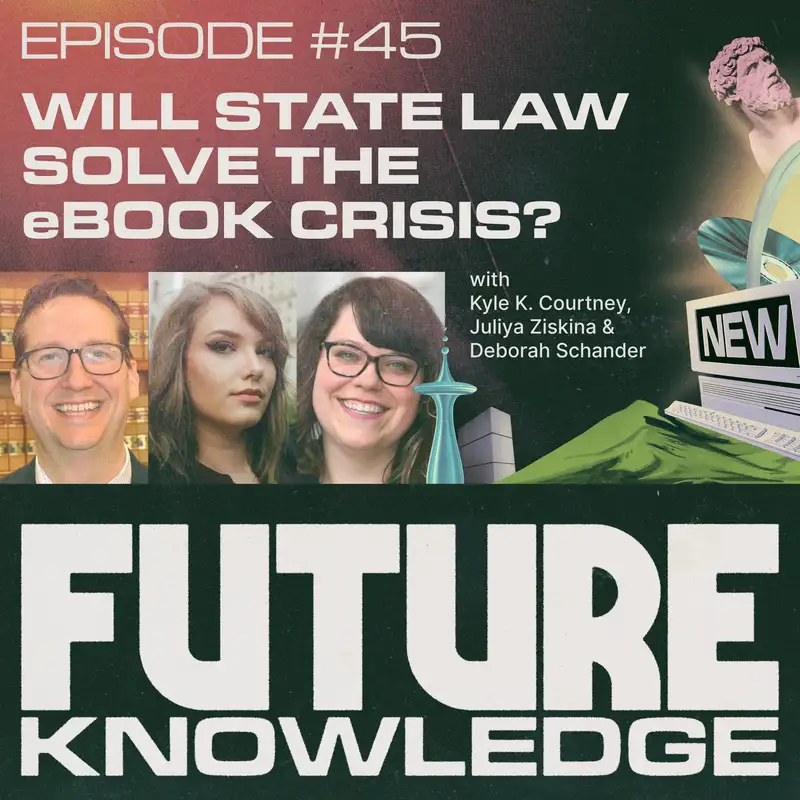
[00:00:45] Now, a growing number of states are asking an important question: If libraries can't own the e-books they buy, can state law give them back rights to build lasting collections? Hi, everyone. I'm Chris Freeland, a librarian at the Internet Archive. Welcome to today's discussion. Today, we're joined by Kyle K. Courtney and Juliya Ziskina of the E-Book Study Group, and Deborah Schander, State Librarian of Connecticut, to explore the growing state-by-state effort to establish fairer terms for library e-book licensing.
[00:01:16] And here to introduce our speakers and to get our conversation started is Dave Hansen, the Executive Director of Authors Alliance.
[00:01:26] Dave Hansen: Thanks, Chris, and welcome everyone. So I'm really excited about today's talk that we have scheduled on state e-book laws, 'cause this is an issue that I've spent a lot of time thinking about over the last 10 or 15 years. Not just at public library levels, but for academic libraries, it's been a real challenge for institutions to navigate what has become a real thicket of licenses and technical measures that effectively prevent libraries from being libraries, that prevent libraries from doing things like preserving books, from lending them out to patrons in a way that actually respects their privacy, and that allows them to do a variety of other kind of normal library things with respect to e-books in the same way that they had previously done with print books.
[00:02:13] So we have, like, an all-star group of folks to talk about what this problem is and, and how some emerging legal solutions, particularly at the state law level, might be a good pathway forward here. So I'll start in reverse order. Juliya Ziskina is here with us, and I've known Juliya for a number of years, and she does a little bit of everything in her role today.
[00:02:37] I'm introducing her as policy fellow at the E-Book Study Group, and she's a lawyer, and she also has lots of background in libraries and cultural heritage, so we're excited to have her. We also have Deborah Schander, who is the state librarian and head of the Connecticut State Library, and she's just got some, some really amazing stories to tell.
[00:02:57] If you're not familiar with this space, Connecticut has done some pretty amazing things in terms of passage of its laws in its state regarding library lending of e-books, so I'm excited to hear from her. And then we also have Kyle K. Courtney who is founder and he says lead troublemaker with the E-Book Study Group, and Kyle has been a longtime collaborator.
[00:03:19] We've worked on lots of things together. So we're excited to hear from these three. I'd love you to just start with, from your work, answering the question, why has providing e-books become such a challenge for libraries, and why has the conversation increasingly turned to state-level solutions?
[00:03:39] Deborah Schander: Absolutely. Thank you so much, Dave, for having me. It's fun to be with you today. So this is a long-standing, complicated issue, but to try and put it in a nutshell, libraries have found themselves caught between their service mission, providing resources to library patrons, and the high cost of providing e-books to those patrons.
[00:04:00] And this is a problem that has been around for some time, since the advent of e-books. Those costs have always been high, but for the most part, libraries were able to manage the costs within the demand that they saw for those resources, and that was within their already typically flat-funded budgets, which is a whole other issue that we could talk about another time.
[00:04:22] But Roughly speaking, COVID really brought this to a head because you suddenly had an increased need and expectation for access to electronic materials. There was no other way to get to some of this information during that time, and so libraries had to shift very suddenly to putting those resources into providing their e-materials.
[00:04:45] And so those high costs became increasingly difficult to manage in that expectation. And so we were not able to buy as much with our money as we had been with print books, for example. So, and then as we have continued through that, even post-COVID, what we have not seen is you might expect to have seen the demand for print to either go down and e-books to remain high or not, but really what we've seen is people have gotten used to both and they want the choice.
[00:05:11] They want both. And so libraries are being expected to provide materials in a variety of ways. So those costs have continued to stay high. And librarians have tried to negotiate with publishers throughout this period to get reasonable costs for those materials, and have just historically found publishers unwilling to negotiate on those costs.
[00:05:33] It is a set cost that is presented, and you accept it or you do not. And so by having those higher costs, it means that the impact is really being felt by... the potential impact is being felt by the patrons. Libraries are feeling like they need to continue buying those materials in order to provide services to their patrons, because if they don't, it's not necessarily the library that will feel that crunch, it is the patrons who are unable to access the information, particularly for those who have no other way to access the information.
[00:06:04] And so that is kind of the situation that we got into with respect to e-materials and then what led to the state's response.
[00:06:11] Dave Hansen: Thank you. Let's turn to Juliya. I'd love to hear from you for your take. I mean, obviously the money and the funding issues are real, but I imagine there are some other pieces here.
[00:06:19] Do you wanna talk a little bit?
[00:06:21] Juliya Ziskina: Yeah, absolutely. Thanks, Dave, and thanks, Internet Archive, for having me here. It's wonderful to be amongst some of my favorite people talking about one of my favorite subjects. As Dave said, I'm actually not a librarian, I'm a lawyer, so from my perspective, I come at library e-book lending from the legal and the legislative side.
[00:06:38] So I've drafted model legislation, I've written legal memos, I've provided testimony in legislatures as a legal expert. So from my perspective in that sense, as a lawyer and as a consumer of books and e-books myself, you would think that digital content should give libraries and readers more access. But instead, very much the opposite has happened.
[00:07:00] There's way less. And that's because pretty much every major rights holder restricts how e-books can be shared or loaned, and those restrictions are in conflict with and, you know, even override the very core functions of libraries, which are interlibrary loan, document delivery, preservation, making accessible copies, and so much more.
[00:07:21] But just because an e-book is a digital file does not make it software. E-books are still books, and e-books should be considered books under the law without being subject to the licensing regulations of a software product. And so fundamentally, this has really resulted in the fact that digital content contracting has created this imbalance of power in favor of the licensors, which libraries simply don't have the negotiating power to push back against.
[00:07:50] So going back to your question, what are we to do then? Well, the state solution started in about 2021 with a bill that was introduced in Maryland, and that basically forced publishers to license e-books to libraries on reasonable terms. I'll explain this later. I'll get more into depth about this. But the bill was struck down on copyright preemption grounds because it mandated that publishers rent e-books to libraries.
[00:08:13] But that brings us to our work today, and I work with Kyle on this. Kyle and I developed legislative language that uses a different approach than this Maryland bill in 2021, and so our work continues today. So instead of mandating that publishers rent to libraries, well, we thought, why not regulate the terms of those licenses themselves on the state level?
[00:08:34] So in other words, what if we changed the license? And so while we might not be able to change this very broken paradigm yet We might be able to use state law to help libraries negotiate fairer contracts.
[00:08:48] Dave Hansen: Thanks, Juliya. All right, Kyle, I can see you're just ready to go.
[00:08:51] Kyle K. Courtney: Oh, yeah. My two colleagues nailed it.
[00:08:53] Like, those are the two things. But to build on what Juliya and Deborah said, the core challenge is the fundamental shift, I think, in how publishers view libraries, and Dave, you got at this a little bit also in your introduction. Just to be clear, libraries, I'm going pre-COVID, Deborah, libraries didn't choose this no ownership e-book rental model, right?
[00:09:11] The publishers became our collection landlords overnight, taking away the critical rights and exceptions that were mentioned here, and those are the ones that libraries rely on to fulfill our mission, and they do this via restrictive terms that are in those contracts, right? So unilaterally imposing a 26 checkout limit, right?
[00:09:26] Or expiring licenses. Again, libraries didn't pick this. This was someone's idea in a cubicle somewhere, and then it became part of the norm, and the norm is that we literally lose our collections unless we pay continually escalating fees, and that sounds like a cartel to me, all without consulting libraries on how this drains library funding meant for preservation, meant for access.
[00:09:50] So it seems to me that the shift and the challenge is, how do we overcome the fact that publishers seemingly view every library checkout as a lost sale, right? Sacrificing decades of non-profit and for-profit coexistence, right? They've always coexisted for pure, pure profit over the public good, and this is exactly why we turn to the states.
[00:10:10] Federal reform is too massive a hurdle as a starting point. Not to mention trying to amend any of these federal exceptions that libraries need leaves us vulnerable to corporate capture, because there's an enormous imbalance in lobbying dollars that exist. So by turning to the states, we can operate on a much more level playing field using existing contract and consumer protection laws that are already there.
[00:10:32] So we're not reinventing the wheel, we're just harnessing it to something that already exists in each of these states So that's how I'll stop right there, 'cause it... they all said it well otherwise.
[00:10:42] Dave Hansen: Thanks, Kyle. And yeah, this idea that, like, every library loan is somehow a lost sale is just, like, bonkers to me, and I hope that in addition to the legal part of this, we can sort of correct that narrative a little bit.
[00:10:55] I mean, I can tell you just from my own experience as a kid, I read through the entire second floor of the Gastonia Public Library, and my parents were not buying me those books. That was not gonna happen. And I think you hear those stories over and over again of, you know, people find and discover things that they would have never encountered.
[00:11:14] And actually, for me at least, what happened was many of those books that I never would have bought, I did buy because I was exposed to them. So I do wanna get into the legal theory. So, you know, eBook Study Group has been thinking deeply about the legal foundations of kind of changing this. So maybe Juliya, you could talk a little bit more of the basic legal theory of the state level approach and kind of the differences between that Maryland bill and what eBook Study Group and Connecticut and other states are kind of looking at now.
[00:11:46] Juliya Ziskina: Yeah, of course. I mentioned the Maryland bill earlier. It's, as I s- mentioned earlier, it basically required publishers to offer ebook licenses to state libraries on reasonable terms. So then what happened was that the AAP filed a lawsuit against Maryland, um, and then the Federal District Court ruled in favor of the publishers, and it declared that the ebooks law was unconstitutional The publishers made the argument, and then the court agreed with, we have our own opinions about that, but they agreed with them, that the e-book law was preempted by federal copyright law.
[00:12:21] This means that copyright is exclusively a creature of the Constitution, so basically only Congress has the ability to pass copyright laws. And the specific issue with the language in these early bills, in the Maryland bill, was this specific shall offer language, which the court basically interpreted as in order to distribute.
[00:12:41] And under federal copyright law, rights holders can sell or not sell to whoever they want to or not want to, and only Congress can interfere with those exclusive rights to distribute. So what we did was, well, we took out the problematic Maryland language. We took out this shall offer, and instead we kind of flipped the idea.
[00:13:03] If publishers want to do business in the state, then they have to abide by that state's laws that regulate contracts, which are literally part of every state. They are consumer protection and state procurement laws. And the states have always had the ability to regulate markets, and libraries have a forward-facing mission that's in service of the public, and therefore state legislatures are well within their rights to pass a law that aids that mission through the use of existing state law.
[00:13:31] So the legal idea behind the bill is that libraries have the power of the state behind them when they negotiate these license agreements, and that contain these inequitable licensing terms. So you asked why start with state law, but there's a lot of advantages to this because, well, first, consumer protection laws are already on the books.
[00:13:51] They govern the formation of contracts and licenses of all sorts of things, and this isn't really a new idea at all, and that kind of makes it an advantage. So some states have net neutrality laws that use this exact same principle, and the right to repair movement also uses this same principle. So what we're really talking here about is the states as commercial purchasers Which again, it's not really new.
[00:14:17] States can and do legally enforce rules in their roles as purchasers of goods and services. There's always been rules attached to states' expenditure of money, and so this is the idea behind state procurement laws, and the e-book bills build on that idea. So that's very different from the Maryland bill because it doesn't force publishers to offer licenses.
[00:14:38] It's assuming that publishers want all of that sweet, sweet library money in the state. Uh- And it says that if they want that sweet money, you have to abide by our state's rules.
[00:14:47] Kyle K. Courtney: Yeah. Juliya, I wanted to jump all over that and clarify something. First of all, Juliya and I did not write the Maryland bill. I just wanna be clear on that
[00:14:53] But we learned from it. That was done by Readers First, who's doing excellent work in the state of Maryland, so I wanna give Readers First a shout-out. They're another organization that we work closely. And again, basing on Juliya, because we weren't implicating copyright deliberately in a con- state contract or a procurement policy bill, we can leverage those laws.
[00:15:11] In the E-Book Study Groups model bills, right, we target these restrictive licensing terms directly by classifying them under the Consumer Protection law that Juliya mentioned, and those are unfair and deceptive acts. Like, we're gonna sell you a book but you don't, right? We're arguing that if a contract forces a library to sign away its core mission, right, those specific terms should be deemed void and unenforceable.
[00:15:35] Now, how are we doing that? Again, laws that are on the books. Now, in the question you said, you know, what's the opportunities and what are their limitations? Are there limitations to state actions? Sure, little bit. Obviously, we can't rewrite copyright law state by state. As Juliya said, that's preemption. So we're always carefully navigating around that, but now we have it in lock in multiple states where it has passed, in other states where it's introduced as a bill and heading towards passage, I believe, and other states that are exploring this.
[00:16:01] This is about public money rather than private commerce. The legal foundation of these bills rests on that bedrock constitutional principle regarding state sovereignty, right? These bills are a direct exercise of the state's traditional authority to establish, regulate, and fund libraries. Heck, we have Deborah right here representing this, and I'm gonna turn it over to her but The legislation regulates how the government spends public money in the public interest, not how private publishers do business across state lines.
[00:16:31] So states absolutely do have the power to regulate how a state, its municipalities, and its libraries negotiate contracts and procure goods. That's entirely within the state jurisdiction. But I'm gonna hand it off to a state librarian right now, 'cause it'd be silly of me to say this, 'cause she has much more experience in this space than I do.
[00:16:47] Deborah Schander: I think what is really wonderful about model legislation is it gives you a starting point and a common place for everyone to have a conversation. And so that's what Ebook Study Group has provided into this sphere, is a new approach to resolving this issue. But there's also a recognition that every state is gonna have slightly different approaches to it.
[00:17:08] Some of the nuances of the law within that state is going to determine some of the changes within that. And so, while Connecticut did work with the Ebook Study Group model legislation, there were some adaptations and changes that were made to fit it particularly within the structure of Connecticut's law.
[00:17:26] And so a couple of those in particular are, if you look at the law, it says nothing about what publishers can or cannot do. What it talks about is the restrictions that are placed on libraries within the state if they are choosing to purchase these licenses, these are the terms that they can or cannot agree to.
[00:17:47] So the only people who are bound by the law in Connecticut are the libraries who are making the decisions to make those purchases. And so if you look at it, it kind of seems like it's restrictive on a library, but it's also very reflective of all of the things, as Kyle said, that libraries actually want to do.
[00:18:05] They are the things that we are looking for when we are trying to purchase and provide materials to others. You also will see that it is limited specifically to libraries that receive state funds. So the state library is one of those, for example. In Connecticut, public libraries are run locally, but they are subsets.
[00:18:24] They're municipal libraries, for example, and so those are, at its heart, state funds that they are receiving, or government funds that they're receiving. And so the It doesn't actually cover any private library, for example, in Connecticut. They can choose to comply, but they are not required to comply. But the majority of libraries that are impacted by the law are encapsulated within that language.
[00:18:47] And then the other thing that we also saw within Connecticut is we're a pretty small state. There was concern about the size of the population and the market impact for how this would really impact the conversation that was happening. And so the Connecticut law includes something that's called a trigger provision.
[00:19:05] The law has passed, it is on the books, but it says that it doesn't actually go into effect until certain terms are met, and those terms are one or more states with an aggregate population of 7 million people or more have also passed a substantially similar law. What that basically means is Connecticut has 3 million people.
[00:19:27] They are hoping to get to a threshold of 10 million people with at least one other state that has also pitched in and says, "We feel similarly. We want to pass a similar law." And once that threshold is passed, then our law will be assessed, will go into effect, and that is when libraries are going to be bound by those terms.
[00:19:46] So it's something that we have certainly seen happening in other states as they're talking about how to do it, but it was a way to both allow Connecticut to be first in the nation to pass a law like this and to move forward in something that we saw legislators feeling very strongly about supporting, while also recognizing kind of the size of our population and the market power.
[00:20:09] So that's how it played out within Connecticut, going from model legislation to passage.
[00:20:16] Kyle K. Courtney: Can I jump in? To give the state rundown real fast, sorry. Connecticut passed, yes. Rhode Island passed, yes. DC passed, yes. Those all have trigger laws associated with them. In the pipeline, Illinois and New Jersey presently, right?
[00:20:30] Introduced into the session, got hearings, and then we have other states we're talking to that are introducing the bills. So just in case you wanted to know where's the pluses and where's the minuses.
[00:20:38] Dave Hansen: If my math is right, either of Illinois or New Jersey would bump this over that.
[00:20:43] Kyle K. Courtney: They have high populations, those states.
[00:20:46] Dave Hansen: Yeah.
[00:20:46] Kyle K. Courtney: The only one that might not trigger is DC because they put a threshold of 10. That's a perfect example that Deborah learned. Each state's slightly different. DC has a different setup. It's signed by their mayor. They don't have a governor. It's a district, but nevertheless, still passed.
[00:21:01] Deborah Schander: Yeah. In our case, our law specifically says it has to be a state, so unfortunately DC wouldn't count toward our threshold.
[00:21:08] All the fun nuances of law.
[00:21:10] Dave Hansen: Gotta be precise. All right, so obviously people are opposed, or some people are opposed, and I wanna talk about, like, who is opposed and why are they opposed to this? Juliya got into it a little bit. We heard about AAP, but I'd love to hear a little bit more about, like, what the opposition has been and what their tactics have looked like.
[00:21:28] Juliya Ziskina: So yeah, it may come as a shock to everyone here that it's the big rights holder lobby and their friends. Wow. But, you know, that's the obvious answer, right? But in our experience, I think one of the main challenges isn't the opposition in legislatures necessarily. Most people we talk to are in support of this.
[00:21:48] It is kind of a no-brainer once you talk to legislators, but the challenge is actually socializing these bills enough so that potential supporters aren't spooked by the AAP and their friends. So for example, I'll talk about some of the tactics. This one really stands out to me. A couple of years ago, the AAP sent this very scary legal letter to lawmakers in Connecticut, and Deborah can talk about more of this too, who were considering the e-book bill at the time.
[00:22:14] I think this was the first round. The thing was, like with this scary letter, was that it was from a white shoe law firm, and it was 14 pages long, single-spaced with like a ton of citations, and the first half of the page was literally just their header with all of the attorneys' names, like, spelled out in teeny-tiny, like, 10 point font.
[00:22:32] And it had all sorts of claims in it about the bill being unconstitutional in, like, very strongly worded language. But once you actually read it, pretty much all of these arguments were a repeat from the old Maryland bill. They took that legal theory and applied it to this one, which is fundamentally different than what the Connecticut bill is doing, as, you know, Deborah explained.
[00:22:51] Ellen Paul from the Connecticut Library Consortium at the time had this great quote, and she said, "It's almost like they didn't read the actual bill." So basically we responded by writing our own 14-page memo Refuting every single claim line by line, because we can do that. But the thing is, the publishers do this.
[00:23:10] They keep trying to conflate the two bills, and then they recycle the same arguments over and over, even though those arguments don't hold. And that all goes to say that most of this opposition is just smoke and mirrors. They may certainly outspend us, but they don't have the law on their side, and I think they know that.
[00:23:29] Kyle K. Courtney: Yeah, so that's one level of a digressive tactics. There's been some others as well, and ones that we have seen. But many of the publishers pulled out all the stops, and I'll include aggregators in there too, who work closely with them for obvious reasons. We've seen them use James Patterson as a mouthpiece for op-eds, and I'm gonna put this in the chat 'cause this is our little e-book study group talk about this.
[00:23:49] But, you know, he wrote an op-ed and basically repeated the 27-page memo, but basically said this is, this is against copyright. And it's not. These are ... Again, these are state contract and licensing bills. They've actually driven digital billboard trucks around state capitals. They did that in Rhode Island recently.
[00:24:06] We've even heard about direct threats happening in the hallways and over the phone, never on the record, literally telling legislators, "Well, we'll just stop selling books to your state entirely if you pass this bill." Guess what? You never sold books to this state at all anyway. You've been renting it to us.
[00:24:22] So that statement in and of itself is false. But this idea is that they've also heavily pressured governors into maybe vetoing. We saw that in New York. New York had a similar law to Maryland and the governor vetoed it, right? And these vetoes or pocket vetoes, which honestly sometimes make you wonder, like why aren't the governors signing some of these bills, right?
[00:24:45] States have a special thing, and if it sits on the desk of the governor for a while and they don't sign it, it becomes law. But, and throughout this, the opposition continuously trots out those copyright arguments, but now they've also trotted out a heavily flawed economic paper, this is the most recent thing to happen, that claims libraries are hurting their bottom line.
[00:25:04] It, it's a full court press of in- intimidation certainly. So that's who's opposed in my view, or at least who we have run into in the States.
[00:25:13] Deborah Schander: Yeah, and I would add to that certainly everything that Juliya and Kyle said of like the reported threats that they will walk away, that Connecticut didn't have the market power, the legal arguments, and seeing something that has a whole lot of Bluebook citations can be very, very intimidating if you're not used to reading something like that.
[00:25:30] But what we also saw was a lot of specific reaction to libraries and librarians. So there were a lot of questions about, well, are you sure that libraries really have tried to negotiate? Maybe you're just bad negotiators. That was something that came up a lot, or legislators who would say, "You know what?
[00:25:50] Honestly, I think that libraries should pay more money for these books, and here's why." And so there were kind of those things that were very specific to it. There was also a lot of conversation about side issues, so it became questions about the content of the materials or how libraries make decisions about books generally that they're adding to their collection, and also just kind of a lack of understanding about how purchases are made, collection development decisions are made, the training that librarians have in order to make purchasing materials as well.
[00:26:23] So absolutely all of the legal arguments, but also some very, very specific resistance to the role of libraries and librarians within the conversation as well.
[00:26:33] Dave Hansen: Thanks. So I wanna turn to, like, how this looks like on the ground in state legislatures a little bit, right? So, like, having a great legal argument is one thing, but actually turning that into legislation is a whole nother thing.
[00:26:50] And so, Deborah, can we start with you to just, could you talk through a little bit of what you've learned so far about what it takes to move these ideas through a state legislature?
[00:26:59] Deborah Schander: Absolutely. And I think that the key thing is having a supporter within the legislature, whether that is one person or several people.
[00:27:09] The movement that happened in Connecticut was because one senator and I were having a conversation literally kinda, I think it was in a parking lot, and we were talking about issues and just he became very, very interested in the topic and moved things forward. And then several other people the next session stepped forward and also said, "This is a topic that I'm interested in.
[00:27:28] I want to help libraries solve the problem." And I think even if libraries are willing to go through the work to do this, it typically doesn't move forward if you don't have that legislative support. You need people who are there on the ground talking with their colleagues, willing to put in the time and the research in order to talk about the issue and move it forward within the legislature.
[00:27:51] There's a whole other set of processes that are happening within legislatures in order to move bills forward. And so having that supporter, I think, or supporters, is really what is driving the conversation and the momentum. And I think there also has to be an understanding and a willingness to know that this may not happen right away.
[00:28:09] I think, yes, it can absolutely move forward very quickly, but in Connecticut, we-- it took four times through the legislature before the bill actually passed. And there was forward momentum, there were back steps, but it meant a lot of librarians showing up and giving the s- essentially the same testimony year after year, or submitting the same information or updating it and, and providing more context.
[00:28:33] And so each time you have to be willing to repeat yourself, to show up again and again, and th-this is not simply a one-and-done process. If it is, that's magical, but that may not be the reality in yours either.
[00:28:46] Kyle K. Courtney: Yeah, and I think, Deborah, that's exactly right because it's what Juliya said too, socializing the idea, right?
[00:28:52] So some states, it takes a couple rounds. I mean, I've spent a lot of time in Connecticut the last four years, gratefully of course, and Rhode Island, right? But for most states it requires that you have to build up the coalition of advocates. We also ha- we have library speaking days. We train folks up locally.
[00:29:10] We also talk the talk, so to speak. So when we're working with it, we talk the library talk, we talk the law talk, and then sometimes we also talk to the attorney general or solicitor general, right? We talk their talk, 'cause they're sometimes involved in this process, and of course our state librarians. But once you empower librarians to explain to their local reps exactly how these contracts hurt their constituents, the momentum can build very quickly.
[00:29:35] Sometimes it can move faster than you think. We've seen some states go from zero to 60, and I will say we wrote a draft for DC, we didn't hear from them for a while, and then before I know it, there was a hearing, and they managed to get it done in a single legislative session. Now, that is highly unusual.
[00:29:50] I just wanna go. We've been working with Rhode Island and Connecticut and New Jersey and Illinois, we've been working for years in this state, so I just want that to well be known that that is about moving the ideas through a state legislature. There's lots of other folks connected that do that, and so we happen to provide what they need at the time period, 'cause we're just good folks.
[00:30:11] Juliya Ziskina: Yeah. So Kyle, I think you covered it, but a, a lot of it comes down to meetings, meetings, and more meetings. Yes. Yes. So a lot of meetings with attorney generals' offices, with legislative council, with legislators. And so we kinda think of it as scriptwriting almost, so the people that carry the bill through legislatures aren't necessarily experts in le- e-book licensing, right?
[00:30:30] And they don't need to be. But we give them plain language for what the bill does. We like short answers about any questions, and a really important part of this is myth-busting too. So we tell them what the publishers will say. They'll say that the bill is preempted, that it forces them to sell, or that it will hurt authors.
[00:30:47] And then we explain why those claims aren't true, and so that when they hear them in a hearing, for example, then they can call BS and respond confidently to those claims instead of being caught off guard and not knowing what to say. So, so much of it is just preparing people
[00:31:03] Dave Hansen: All right. So we're getting lots of questions about like, what about my state?
[00:31:06] What about my state? So let's, let's talk about, like, let's say a state successfully passes an ebook law. What happens next? I mean, obviously we talked a little bit in Connecticut of, like, you've got this trigger, so maybe we can talk a little bit about that, but more generally, I guess, like, what does it take to actually and successfully translate legislation into something to meaningfully change how libraries could provide digital collections?
[00:31:33] So Deborah, I think that's really a question for you.
[00:31:36] Deborah Schander: Yeah. No, absolutely. So we're certainly in the waiting period here in Connecticut. Like, the law's passed, we're waiting for the trigger. So we're not quite sure what the next steps will be, but I think what it's raising is a lot of questions about buy-in.
[00:31:52] Are libraries willing to go through this process once the law goes into effect? Because it can be really scary to be the first ones to take that step, and we don't know exactly how this is going to play out, what it's going to mean, if there is going to be an impact on contracts and the ability to provide resources to patrons.
[00:32:11] And so it can be difficult to do that, and so are you willing to engage in that? And on the other side, I think the question is just one of purpose. Like, is the purpose to simply make money? Is the purpose to provide books to patrons who are wanting to read them? Maybe, probably it is somewhere of both.
[00:32:31] It's somewhere in between, and the question is, is somebody willing to step forward and move the needle on the difference between bringing money into your company and providing those resources? So those are sort of... Those are really the big questions that we're asking right now of what happens next, and will we see a shift in that distribution between dipping profit and providing resources.
[00:32:53] Dave Hansen: I wanna ask just, like, kinda one high-level question to you all, because obviously passing a state law is not an end in and of itself. And so I'd like your take on what does success look like with this strategy? And how about Juliya? We'll start with you.
[00:33:09] Juliya Ziskina: Yeah. Yeah, so, so much of the discussion has been focused on these legislative efforts about licensing, but I wanna be very clear that the legislative efforts that we're talking about kind of just mitigate the problem, but they don't solve the issue of corporate contract override of a library's public interest mission 'Cause I mean, in and of itself, licensing's not the answer.
[00:33:31] It doesn't solve this renting problem because when someone has full control over the thing that they supposedly buy, like, do they actually own it? And then can you use it in ways that you would use things that you own? And the answer is, of course, no. So the fact that libraries don't have ownership of their materials is the crux of this problem, and the files sit on these platform servers, and libraries only rent access.
[00:33:55] But you know that, that's our present reality. Publishers force libraries into this, and they need help now. So I see the success in, like, two stages almost, short-term and long-term. In the short term, I see it as functionally a library should be able to do with an e-book what it can do with a print book.
[00:34:12] So meaning it can lend it in the same ways without the exploitative license expiration terms. They can use interlibrary loan, they can preserve it, accessible copies, all of that, and they can also preserve their patrons' confidentiality too. So libraries have had those rights for generations, but licensing terms have artificially taken them away, and the bills just aim to give those rights back.
[00:34:36] But in the long term, uh, success to me means digital ownership Libraries should own their digital materials, not simply rent access to them that can expire, that can change price, or even just simply disappear. Ownership is what makes it possible for libraries to build real, actual collections and to preserve digital materials for purely public interest motives.
[00:35:00] And at the end of the day, libraries can't build collections on a corporate lease.
[00:35:05] Kyle K. Courtney: Heck yeah. Yeah, I know, I just-- I always love that. So good mic drop. Ultimately, success looks like critical mass for me, right? If we can get enough states to act, it fundamentally changes the national landscape, right? We're also recognizing that state legislation is just one tool in our toolkit.
[00:35:21] Ebook Study Group is actively exploring antitrust avenues. That's right, state antitrust law. We have a paper coming out on this. State executive orders, got a paper on that too. And administrative law, specifically utilizing consumer protection law, which u- some states exist in administrative law, like executive branch of government.
[00:35:39] I don't wanna get into a three branches of government lecture. But again, using this to enforce consumer protection against these deceptive contracts. And I wanna be clear, the point of these tactics is not to get bogged down in endless litigation, right? The point is to bring the coercive power of the state behind the libraries at the negotiating table, right?
[00:35:58] Right now, libraries have no leverage against these massive publishing conglomerates. When you introduce the coercive power of the state, whether you're through a piece of legislation, executive order, an AG consumer protection investigation, you rebalance the scales. By hitting this from every possible state angle, we force the issue.
[00:36:14] Once we build that critical mass and put the state power behind us, we can finally turn back to the federal side, but this time from a position of true power, and negotiate a real meaningful amendment that we could do that would fix this problem from the beginning That's what it looks like to me.
[00:36:32] Deborah Schander: It's really hard to go after both of those, I have to say.
[00:36:34] But I think from the library perspective, you know, helping legislators and patrons and others understand that this is an issue is really significant, too. Like, we in this room know that this is an issue, but there are still many people who don't even understand that this is a problem, and libraries are often seen as that magic, mysterious place where, you know, you go in and somebody provides you with what you need, and you don't see any of the work or the effort or the professionalism that went into providing you with that.
[00:37:06] And this is one opportunity in which we can present to the world the library as a profession, as a service, and what that means for everyone. And so even just pulling back the curtain to show people better what libraries are doing on their behalf I think is really important part of the conversation, too.
[00:37:25] So that's what I would end with.
[00:37:27] Dave Hansen: Awesome. Thank you. All right. How do regulations and practices related to e-books compare to regulations and practices related to movies and videos? And I'll throw other formats in there, too, like audio. So it would be helpful if you could talk through that, and also there's kind of a more fundamental question that would be helpful to address along the way, which is just why in the world are e-books treated different from physical books to begin with?
[00:37:52] Kyle K. Courtney: Yeah, yeah, yeah. So that's a great question, and we sh- we probably should... It all comes down to one, one fundamental shift in legal classification which we touched on, ownership versus licensing, right? That single shift moves libraries out of the protections that they have, the federal exceptions they have, and traps us in a restrictive world of contract law.
[00:38:13] When a library or anyone else buys a physical book, we're protected by a bedrock principle called first sale, right? The law essentially says once a publisher sells a specific physical copy of a book or an item or a DVD or a movie, their control of that specific copy ends. They got paid for the sale, and now the library or the person owns the physical object.
[00:38:31] We can lend it, we can preserve it, we can rebind it, we can put it in a box until the pages crumble, right? We never have to ask the publisher for permission to pay them another dime. We have it. But publishers recognize the loophole in the digital formats drawn from the software industry, which Juliya pointed out in the beginning.
[00:38:46] They decided an e-book is not a book being sold, but rather a piece of software that's going to be licensed. Because e-books are licensed, the relationship is no longer governed by the balance exceptions built into the Copyright Act, meaning it's governed by a private contract, so without a sale- Instead of a rental.
[00:39:01] Without a sale, there's no first sale. And this was written a long time ago, but if a publisher writes a contract that says a library can only lend 26 times before it self-destructs, and the library is forced to click agree to get the book, the law enforces that contract, right? And so just to be clear, libraries can use the same digital technology and digital files that the publishers use, right?
[00:39:22] We all have this technology, we have all available to us. Heck, Connecticut has a state e-book platform technically for some of its work that it developed in the '90s. And this is exactly why I said they became our collection landlords overnight by treating e-books as software or rentals or something like that.
[00:39:37] You know, the rent is too damn high. Publishers legally bypass the first sale doctrine, and this is precisely why our state level strategy is so vital, right? If they're taking our rights away via contract, we're using state contract and consumer law to fight back.
[00:39:52] Dave Hansen: Thank you. I mean, it's wild to me that for e-books, instead of their use being governed by laws that are democratically passed by Congress or state legislatures, they're governed by like whatever lawyer Amazon or OverDrive or whoever happened to hire to write those things out.
[00:40:08] This is crazy. All right, so then the other piece of this was the difference between formats, e-books versus, you know, movies and videos or other kinds of things. So I'd love to hear your take on kind of how those two things differ and how maybe approaches to those may differ.
[00:40:23] Kyle K. Courtney: So it's not just e-books obviously, we also have audiobooks.
[00:40:27] We also... Heck, I rented my first VCR from my library, and the tapes, right? I've rented art from my library. I've taken all sorts of things. I've borrowed all sorts of things from the library. But this is a, I think it's a problem that's of a national scale, right? The technological format, whether it's an EPUB, an MP3, an audiobook, anything like that does not change the underlying legal strategy.
[00:40:45] State level contract and consumer protections approaches that targets the licensing agreement itself, not the file extension Right? This is why the definition section in all the bills rewriting is so critical, right? If a state bill narrowly defines the asset as just a text-based electronic book, it accidentally leaves out digital audiobooks or maybe research databases.
[00:41:06] So we discuss with the states how to broaden or narrow that statutory language, and sometimes we just say, "Electronic literary materials or digital library products," right? So again, that's where we're coming from with this. I don't know if anyone else has a, a jump into
[00:41:19] Dave Hansen: this. I'd love to know how the Connecticut law handles that.
[00:41:22] Deborah Schander: It does cover electronic or e-audiobooks as well, so it is trying to address those, and the costs of e-audiobooks are typically even higher than of e-books. I saw a question about, "Can I buy an e-book and give it to my library?" Unfortunately, no. Consumers are actually constrained. You are also buying a license to access.
[00:41:40] You are not buying an e-material as well. So purchasing a DVD, a CD, things that libraries have lent out for many years, because it was a physical object, it was subject to that same first sale doctrine. It's why you can buy clothes at secondhand markets, things like that. But anything that is in that electronic format has been moved to this e-licensing, and so it's why, you know, there- you're seeing this return to analog living movement, people who are talking about going to thrift stores and buying DVDs and things because people have become so frustrated with the streaming market, and disappearing items, and people making the decisions about those materials as well.
[00:42:18] You know, some of you may have purchased a license on, for something on your Kindle, and it's been changed or it's been removed overnight because you have no authority over that. Same with audio, same with other materials as well. So yeah, it is something that is a broader issue than just the e-books.
[00:42:34] Kyle K. Courtney: And one last thing.
[00:42:36] Any of these laws passing in a state doesn't mean publishers stop getting money. I wanna be clear on that. Libraries, if they have a million dollar budget, they're gonna spend a million dollars. If they have $5,000, they're gonna spend $5,000. The difference is, do you only get the same 50 books that you're re-renting over and over, or do you get 5,000 books 'cause it's freed up this kind of notion?
[00:42:54] And this is why we get both sides of the aisle in every state, right? It's about access and things, and socioeconomic, and libraries should exist, but also it's about wasting tax dollars, throwing money out the window, basically re-renting and re-buying the same material over and over. So I just wanted to pop that in there.
[00:43:09] Deborah Schander: Dave had mentioned too at the start, like, it's not that libraries want to spend less money, they're wanting to spend more money on more authors, and being able to introduce more people to authors beyond just the ones that are at the top of the bestseller lists. And so it's about providing more and more access to broader ranges of things and hitting more interests on the part of library patrons, not just the ones who are asking for the major materials right off the bat.
[00:43:35] Dave Hansen: I have one last one I'm gonna throw in here. So we've talked about- State laws. And I think one obvious question is, gee, we have this Congress thing in DC that, you know, passes laws that apply to everyone. It seems like a long shot, but could we talk a little bit about, like, is there a pathway to updating laws at the national level?
[00:44:00] Juliya Ziskina: I mean, my response to that is, have you seen our Congress lately? Uh, the problem right now with going the federal strategy, as much as we all would, would love to do that, the reality is that the publishing lobby has a lot of money. They outspend us. There would be corporate capture, and so that's why we're building the strategy kinda from the ground up in a way.
[00:44:21] If there's a groundswell of states that are passing these laws, that signals to the federal government, "Hey, there's a problem here. We need to address this." So it really gets us past that threshold and that barrier of even bringing this to Congress and getting them to care. I've done meetings with Congress about copyright issues, and it's usually a very nice meeting.
[00:44:43] The staffer sits like, "Mm-hmm, mm-hmm. That sounds like a problem." But unless there's a real incentive for them to actually do something about this, it's just realistically, it's hard to... You know, it's kind of like pushing a boulder up a hill, just at this stage. And so that's why we're focusing on e-book laws, as a way to catalyze it.
[00:45:04] Dave Hansen: So I just wanna thank you all for this great conversation. Thank you for taking the time to do this today. And there's one takeaway. I think the takeaway to me is that librarians actually have a lot of power here if they organize and try to make their voice heard at their state legislature. So raise the issue and, and speak out.
[00:45:23] Chris Freeland: For thank yous, a big thank you, of course, to Deborah, to Kyle, to Juliya, for the, such a great conversation. And as always, to Dave Hansen and to Authors Alliance for facilitating and co-hosting these sessions. Thanks, everyone. Have a great day.
[00:45:38] thanks for joining us on this journey into the future of knowledge. Be sure to follow the show. New episodes, drop every other Wednesday with bold ideas, fresh insights, and the voices shaping tomorrow.