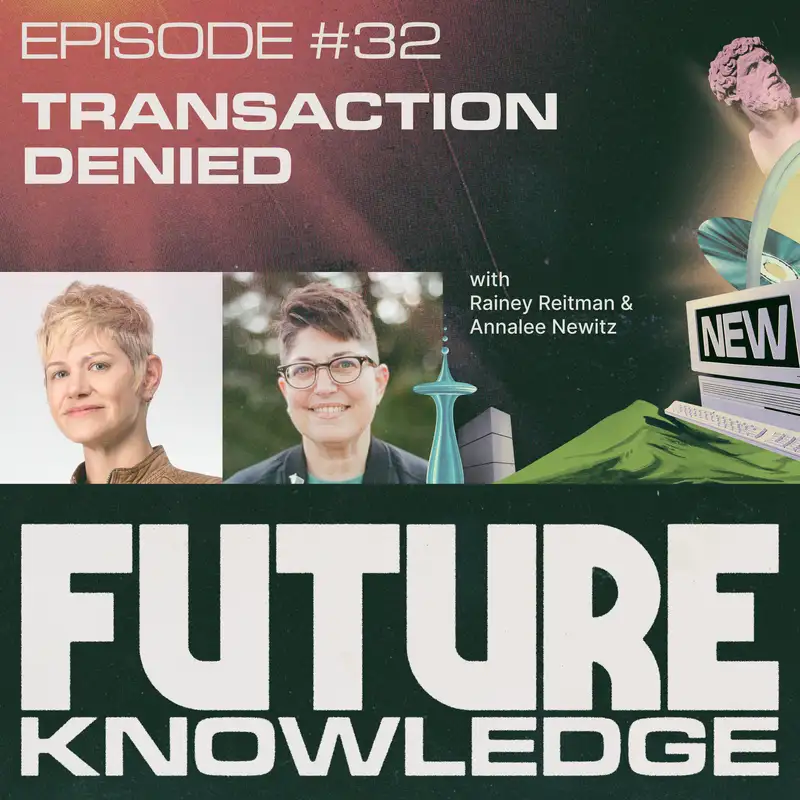
Transaction Denied
Download MP3[00:00:14] Chris Freeland: We tend to think of censorship as something obvious, a banned book, a deleted post, a government telling people what they can and can't say. But increasingly, some of the most powerful forms of censorship are happening quietly through payment processors, banks, and financial platforms that can cut people off from the ability to raise money or run a business.
[00:00:36] So what happens to free speech when private institutions can block your ability to participate in public life? Hi, everyone. I'm Chris Freeland, and I'm the librarian at the Internet Archive. I wanna welcome you to today's conversation. In Transaction Denied, Rainey Reitman explores how financial institutions have become powerful gatekeepers of public expression and what that means for democracy and dissent.
[00:01:00] Rainey will be in conversation today with author Annalee Newitz. And here to introduce our speakers is Dave Hansen, the executive director of Authors Alliance.
[00:01:11] Dave Hansen: Thanks, Chris. I'm super excited about today's talk. This book is just such a fascinating book and exposes a part of the world that I think most of us don't think much about.
[00:01:20] So I'll get out of the way here in just a second. I wanna introduce Rainey Reitman, who has been on the podcast before, and she is the author of Transaction Denied: Big Finance's Power to Punish Speech. It exposes how companies like Visa, Chase, PayPal, Bank of America, and Mastercard use their power to silence dissenting voices and hurt democracy.
[00:01:43] And she's co-founder and board president of the Freedom of the Press Foundation, which defends the First Amendment and journalists, and is a writer, facilitator, and civil liberties activist. She also runs her own nonprofit consulting service. In conversation with Rainey will be Annalee Newitz. Annalee is a science journalist who also writes science fiction.
[00:02:06] They're the author of several books, including Automatic Noodle, an instant USA Today bestseller, The Terraformers, which was nominated for the Nebula Award, and Four Lost Cities: A Secret History of the Urban Age. They have a monthly column in the New Scientist magazine and are a member of the Flaming Hydra Collective.
[00:02:26] So with that, I will turn it over to Rainey and Annalee.
[00:02:32] Annalee Newitz: Great. Thanks so much for having us on. Rainey, I am so excited to talk to you about this book because when I first read it, I got a- an advance copy and I got to see it before the masses, and I really felt like, why has this book not existed before?
[00:02:49] Because so many of the things that you talk about in it are things that people I knew, friends and colleagues had experienced, but had been told weren't really happening or weren't happening for the reasons they thought. And it was like they were being gaslit, and then this book comes along, and it's like, nope.
[00:03:06] Mm-hmm. And I know that you also became concerned about this because of a personal experience that you had. So I wonder if you could talk to us about that origin story for the book.
[00:03:19] Rainey Reitman: Absolutely. Also, Annalee, I have been a huge fan of yours for years. It's such a delight for me to get to have a conversation with you about my book, and so I'm just thrilled to have this conversation.
[00:03:31] So I also couldn't believe that this topic had not been the subject of a book already when I was first thinking about turning this into a book and looking around and realizing, like, "Hey, how could this have been going on for years, and yet there's been literally no book written about it?" So now thankfully there is.
[00:03:47] And when it first came on my radar was when it, it happened to a nonprofit project that I had co-founded back in 2010, which was raising awareness and advocacy for Chelsea Manning, the whistleblower- Mm-hmm ... who gave documents to WikiLeaks, including collateral murder, which shows American soldiers gunning down people, including children and journalists.
[00:04:10] I was very personally moved by the documents that Chelsea released to the public, and I wanted to make sure that she had the best chance possible in court and to tell people her story, right? So we were working a collective that was umbrella-ed beneath a larger nonprofit to kind of raise awareness about her.
[00:04:28] And shortly after the WikiLeaks blockade was put into effect, our nonprofit also had a sudden freeze on our PayPal account, and it was incredibly difficult for us to get it resolved. At first, we tried talking to folks within PayPal. I had good contacts thanks to my relationships through consumer advocacy work.
[00:04:49] And in the end, I kept hitting dead ends and ended up launching a publicity campaign and using public pressure, including a big petition with 10,000 signatures, phone calls from journalists, articles being written to get PayPal to change its positions. They reinstated our account, but for me, it created this question of, "Who else is this happening to?
[00:05:13] How many other nonprofit groups or advocacy groups are suddenly losing access to the financial system, and how is that disrupting society?"
[00:05:21] Annalee Newitz: I was just curious if PayPal ever told you guys what their rationale was behind shutting down the account. Did you ever get any- Yeah ... kind of satisfaction? Any information?
[00:05:35] Rainey Reitman: Well, they were pretty dodgy in giving us answers. At first, they said they were looking into it. At one point they said it was getting resolved, and then they said we needed to give them more information, so we gave them, like, Social Security numbers and things like that for people involved. They said we needed to open a line of credit.
[00:05:52] We opened a line of credit. And then they said that they tried to cite the Patriot Act for a little while, and I pushed back- Oh, shitty ... on them around that. I was like, "What's... You know, the Patriot Act's been around for a while. I don't think anything's changed since we started this PayPal account in the last couple weeks about the Patriot Act, so why now?"
[00:06:11] And in the end they said it was an internal policy, and that's all they would say. It was an internal policy, and I'm pretty sure it was an internal policy, because if it had been a legal requirement, they would never have caved to public pressure. So as is the case in a lot of these situations, it's hard to get companies to really put into writing the specific thing that is causing them to close your account, and that's why my research in this area took so many kind of twists and turns, and I was very obsessive about when I could get companies to say something in writing, in an email or in a letter.
[00:06:47] I would transcribe it. I would get the entire thing into the book, because it's sort of these little breadcrumbs leading us to, you know, down the path of, like, what's really going on with these companies.
[00:06:57] Annalee Newitz: Yeah. It's so interesting because- This idea of an internal policy that can govern speech, it seems like this is kind of a hallmark of what you're calling financial censorship.
[00:07:13] So I'm wondering, do you have kind of a hard and fast definition of what financial censorship is?
[00:07:20] Rainey Reitman: Yeah. So I define it as instances where financial companies limit or close the accounts of people in connection with a form of legal speech. And so I'm specifically looking at law-abiding people who suddenly find themselves cast out of some part of the financial system.
[00:07:40] And getting that connection between what someone says and the loss of their financial accounts is sometimes part of the investigation, but that's specifically what I'm looking at for financial censorship, as compared to a broader term like debanking, which might have no connection to speech whatsoever.
[00:07:59] Annalee Newitz: So the goal is, as you're investigating, to try to draw a causal connection between something that someone has said and then losing access to financial services. And I wanna be clear about what the kinds of services are that people lose, right? Like, sometimes it's I'm a business and I can no longer do credit card processing, but what else is there?
[00:08:22] What kinds of ways can financial companies crack down on people for their speech and kind of cast them out of the financial system?
[00:08:30] Rainey Reitman: Yeah, that's a really good question. So I investigated three different types of financial exclusion: losing access or being denied access to a bank account, losing payment services, and then losing credit cards.
[00:08:45] And I put these forms of financial systems into a bucket of, like, sort of necessary for someone who is trying to run a business online or somebody who is trying to have a nonprofit or a journalistic institution or a content creator. Like, for folks like that, these are very fundamental services. And so losing them, it's a threat to the future of their livelihood and can have massive, severe consequences for their day-to-day lives, uh, even if it's only for a sh- a defined period of time.
[00:09:20] I didn't look at things like investment services or, you know, there's a lot of crowdfunding campaigns, and there are certainly speech ramifications to those types of issues, but they don't cut as close to whether or not a business can continue to exist as, for example, the ability to receive- Online payments.
[00:09:40] Annalee Newitz: Yeah. I mean, it's especially, as you said, when so many journalists are starting up their own newsletters or they're trying to support- Mm-hmm ... themselves with what they write, or artists who are trying to support themselves with what they create online, that may be their only ability to make money, right?
[00:09:56] So it's effectively firing people, in a sense, from being self-employed which is- How- ... not supposed to be a thing that can happen.
[00:10:04] Rainey Reitman: Yeah, I think that's right, and one of the themes I really noticed in the book is that losing access to one payment service can, in many instances, create a cascading effect where people are shut off of other services, and it may not even be for the same reason.
[00:10:21] So, like, a financial service may notice that you lost your credit card, and so that impacts your credit report, and then maybe you lose another credit card, not because of anything you did, but because you had just lost that first credit card, and that raised enough of a red flag to create concerns. So there can be these cascading effects where-
[00:10:41] losing one service can result in other services later being closed or denied. That doesn't always happen, but I certainly spoke to a number of folks who had struggled with that.
[00:10:53] Annalee Newitz: Yeah. That is just terrifying, especially- Mm-hmm ... because of how much of this is, I mean, I wanna say shrouded in secrecy, but it's also shrouded in bureaucracy.
[00:11:04] And so like you said, people may not know why their account was shut down, and then if there's this knock-on effect and suddenly now they can't get another credit card or they can't open a bank account or something, they may never know. Like, they may just be told, "Sorry, no," and if they don't have the ability to do an investigation like you, they might just be screwed forever, which is really...
[00:11:28] I feel like this is something that is dramatically different from the type of censorship that we're used to talking about in the United States. Like, we're used to thinking about government censorship, like that there's one kind of censorship- Mm-hmm ... it's covered in the First Amendment, and that should be it, right?
[00:11:45] Like, if we aren't being censored in that way, then we're not really being censored. And even though, as you document in this book, so many of us have experienced financial censorship, and I wonder, do you think that there's a kind of reluctance to see this as censorship because this is a relatively new phenomenon?
[00:12:04] Like, is this a 21st century thing that we're seeing financial companies kind of putting their thumb on the scale of who can be paid for their speech? Or is it this has been going on all, all along? Tell me a little bit about that context.
[00:12:20] Rainey Reitman: Yeah. Well, there's a couple different ideas that are coming up for me.
[00:12:23] First is the impact of this type of punishment has dramatically changed as our lives became more online, right? So, you know, 40 years ago, losing an online payment service wasn't a thing, right? Right. Much less a massive blow to your newspaper. And so our systems of payments have totally gone online in ways that have allowed so many content creators to reach new audiences, often global audiences, that really wouldn't have been possible before.
[00:12:55] And I think we often frame that as this is opening avenues and opportunities that could never have existed before the internet, but it's also creating these vulnerabilities, and those vulnerabilities are being shrouded, as you say, in bureaucracy and in secrecy. So I think that's one of the big things we need to think about.
[00:13:16] What was your second
[00:13:17] Annalee Newitz: part of your
[00:13:18] Rainey Reitman: question? Or what was the...
[00:13:21] Annalee Newitz: So part of it was like- Yeah, I was very in
[00:13:22] Rainey Reitman: talking about that, then I forgot
[00:13:24] Annalee Newitz: what I was gonna- No, that, and that was a great answer, and it's, it is really interesting. So you answered the sort of when did this start happening, and then I think the other piece of it is why do you think people are so reluctant to- Yeah, you talked
[00:13:36] Rainey Reitman: about government censorship.
[00:13:37] Yep ...
[00:13:38] Annalee Newitz: yeah, to put this in the same bucket as censorship, but if it's not from the government, it's not really censorship.
[00:13:43] Rainey Reitman: Yep. Okay, that's a great question too. We know that if the government engages in direct censorship, that's censorship. But what does that look like in the corporate world? And I think there is a pretty robust conversation happening, for example, within social media context where we know that the decisions that major social media platforms like X, like Facebook, like Instagram, TikTok, about what kinds of speech, not only that they'll host, but that they'll promote, that they'll allow their algorithms to surface, that that can have a huge impact on speakers, on readers, and frankly on society.
[00:14:19] And so there's a pretty evolved conversation there about what censorship looks like. What I think has been missing is the idea that financial companies are also putting a thumb on the scale in a lot of circumstances, that financial companies are assessing the content on websites and deciding whether or not they should have access to the financial system, um, that they are getting pressure from advocacy groups to cut off certain types of speakers.
[00:14:46] And that conversation, I think, has been happening for a long time, but it hasn't been surfaced for the public. And so that was really one of my goals with the book was to say, and I think this is true with any kind of online speech issue, is you have to ask not only like, well, is this about a form of speech that's legal and, and are we measuring the correct things here?
[00:15:05] Are we weighing the right things? But also who is doing that measurement? Who is weighing those costs? And right now there's a whole set of situations where financial companies like credit card companies are making decisions that impact online speech, and I don't think many people even understand that's going on.
[00:15:25] Annalee Newitz: Yeah. I mean, one of the things that's really terrific about this book is you have a lot of legal analysis and economic analysis, but you're also, it's really rooted in the stories of people who have been censored by financial companies. And I wonder if you could talk to me a little bit about who the people are, like if there's a pattern in the kinds of people who get targeted, and what you learned about who the people are in the companies that are censoring them.
[00:15:54] So that's sort of two questions. One is who are the people being targeted?
[00:15:57] Rainey Reitman: Damn it, Anna Lee with the double questions.
[00:15:58] Annalee Newitz: I know. I'm, I'm like double pilled.
[00:16:01] Rainey Reitman: Let's start with the question of who the people are that are being targeted, and then let's get to the, the bad guys.
[00:16:06] All right.
[00:16:07] So the people being targeted, I would say that my biggest takeaway from doing this investigation, and I started kind of looking into this 10 years ago when I was at EFF, and I kind of struggled with this with my own nonprofit project. But then I've been- Yeah ... collecting a ton of stories, and I really sat down to write the book and did a lot more research back in 2023, and my impression, my big takeaway is this: Mm-hmm
[00:16:30] which is that the people who lack power in our society in other ways are the most likely to suffer negative consequences due to financial censorship. So they are the ones who are going to really struggle with losing a PayPal account or having their bank account closed or losing online payment services.
[00:16:51] So what are some of those communities looking like? I specifically looked at political activists, and they really ranged from across the political spectrum, which I thought was an important story to tell. My goal was in reading this book, everybody would have someone that they could relate to, but also maybe somebody that they didn't like that much, right?
[00:17:09] That, that you would get to ask this question about, you know, fundamental right to access the financial system, even for people you don't like. Did that change things for your analysis? And I wanted the reader to really go through that. So I looked at activists, I looked at journalists, I looked at online content creators in the adult space who've been struggling with this for so long.
[00:17:29] Hmm. I could have written an entire book just about that. I looked at the disproportionate debanking of the Muslim community, talking to Muslim content creators, Muslim nonprofits, people in that space. And then I also looked specifically at the cannabis community and For example, legal nonprofits or journalists operating in the cannabis space basically getting sideswiped by these anti-cannabis laws.
[00:17:53] And I would say that I did not intend to have a chapter on cannabis, and it just kept turning up again and again and again, and I realized there's a really important story to tell there, and it is part of this larger conversation about online censorship, and I had to put it in.
[00:18:09] Annalee Newitz: Yeah. Well, I mean, and it's also a great example of a type of entrepreneurialism that is legally in a gray area in some places, and that's also just demonized, right?
[00:18:22] Just like sex work, where you have people who are doing perfectly legal things, but it's just something that politicians don't like or maybe some jerk at the bank doesn't like. Yeah. So that's me saying jerk. You didn't say that. But I do-- I am really curious, like, as you looked at these different communities, marginalized folks, activists, journalists, people in the cannabis community and the sex work community, these are people who are all interacting with the same financial institutions.
[00:18:54] So what was the impression that you got about who the people are at these financial institutions that are making these decisions and saying like, "That guy is just too much cannabis going on over there," or like, "I just don't think that account should be allowed to exist"? Like, do financial institutions have, like, job titles for those people?
[00:19:14] Hmm. Like, are they social censor, or what's happening there?
[00:19:18] Rainey Reitman: I think a phrase that gets tossed around a lot is compliance officer. Okay. And so certainly not the only role, but there's someone I quote in my book who had this great quote about the banks, and he said that bankers are not known for their great moral fortitude and that the bankers are akin to long-tailed cats in a rocking chair store, and that that is their relationship to regulators, is that they are jumpy and quick to over-interpret what the law requires and- err on the side of shutting off accounts rather than consider nuance or the speech implications of their decisions.
[00:19:58] So I think that's definitely the case, that there's a set of policies that were put into place by financial companies who are overextending themselves to hyper-comply with laws that maybe said something that didn't go quite as far as what they ended up implementing. We also know that financial companies have gotten very direct pressure from the government in a number of circumstances, and I have some of those examples in my book, including the Backpage case where a sheriff sent a letter to Visa and MasterCard saying that as a father and a concerned citizen and as a sheriff, he wanted them to shut off payments to backpage.com.
[00:20:37] And Visa and MasterCard complied. They immediately shut off payments, and that kickstarted a lawsuit that EFF actually ended up being amicus on, which was great to see. So sometimes there is pretty overt pressure from the government. Sometimes it is more like the companies have compliance officers who are overextending themselves.
[00:20:57] And then sometimes, and we've seen, I have a couple examples of this in the book, there's industry guidance. So other financial companies are putting out guidance or suggestions, and then different folks within the financial community will do their best to try to interpret what they're getting from other financial companies.
[00:21:15] So there's all these different forces that are pressuring financial companies to engage in different forms of censorship and closing accounts. Very few forces on the other side that are encouraging them to keep accounts open and to really, you know, stand up for their users. And then the individual experience of it is often hyper-bureaucratic, automated, and nonsensical.
[00:21:40] I liked, and it was important to me to include at least a couple examples where I actually got transcripts of conversations that users had with their financial institutions trying to explain what was going on and get answers, since you could see these incredibly Like unhelpful, courteous, pointless responses that they were getting that, I mean, either they're working off of really terrible scripts or these are AI-generated responses, and so that the reader would get to experience the almost sense of helplessness of trying to fight the bureaucratic decision that is, that they're getting caught up in.
[00:22:21] Annalee Newitz: Yeah. Trying to fight it while also being worried about paying bills a lot of the time. Right. Yeah You know? 'Cause you're already in a stressful situation. The other thing I was wondering about was I thought it was really great that you said there's very few people doing pushback on the other side to keep accounts open.
[00:22:37] So where are we with that? Like, have there been any consumer revolts against these companies? Mm-hmm. Or is there any kind of recourse for someone who's trapped in this weird nightmare?
[00:22:50] Rainey Reitman: I would say there's a patchwork of efforts to try to stop this from happening, and it's often issue-specific. So for example, there are congressional bills to try to ensure that folks within the cannabis field can have access to the banking system, and there have certainly been effective and powerful publicity campaigns that have been launched, including several that we launched at EFF that effectively got financial accounts reinstated for online speakers who had not broken the law.
[00:23:19] And then there's sort of a, a patchwork of other things happening. So for example, the Trump administration, after my book was published, put out a executive order against debanking that required financial regulators to remove reputational risk as a factor in their regulatory guidance, and it did a few other things as well.
[00:23:43] But that was an interesting move, and I welcomed it, this idea that we would remove such a nebulous term, right? Reputational risk. Like, why were banks even looking at, at tarnishing their reputations by doing business with certain customers? It just seems like such a strange things for them. Like, why was that even in regulatory guidance, and certainly undefined as well.
[00:24:01] But that did not result in, for example, a incredibly neutral and fair and accessible financial system suddenly becoming available. And I think a clear example of that is the recent donation blockade that the Southern Poverty Law Center is facing, where Charles Schwab, Vanguard, and Fidelity have all blocked donor-advised funds from reaching SPLC right when they need it the most.
[00:24:26] So there's certainly... It's still an ongoing live issue, and I don't think there is sort of a larger strategy around this. Sorry I don't have better news.
[00:24:38] Annalee Newitz: But I think it's important that people are more aware now, and one of the things I think you argue really persuasively is that we really need to- change the way we think about financial services, and how should we reframe our understanding of financial services and financial companies for this moment?
[00:24:58] Rainey Reitman: Yeah, for this moment, given where we are today with online commerce, I think we need to be thinking of financial services as a type of internet infrastructure, right? So this is something that should be happening quietly in the background and not engaging in the kind of detailed content moderation that we might expect from a platform that is hosting speech directly, right?
[00:25:24] So for website hosts that are actually, like, you know, like your Meta or TikTok that have policies in place that are hosting speech directly, we could expect them to have pretty detailed content review policies. And I'm not saying that they get it right at all, I would never say that. Mm-hmm. But I am saying that they're far better positioned to weigh in on those issues than a credit card company, which has literally no business weighing in on those issues at all
[00:25:53] Annalee Newitz: Yeah, they're not a content company-
[00:25:55] Rainey Reitman: They're not
[00:25:56] Annalee Newitz: a financial services company, which it sounds to me like based on some of what you discovered, that these banks are seeing themselves kind of as an etiquette school. Like they're really worried about reputation, and like they're also setting themselves up as editors and arbiters of taste, and I just don't think people get trained to do that in like, you know, in school where they're learning about accounting and marketing and that kind of stuff.
[00:26:21] Rainey Reitman: Um- Absolutely not. No. And can I just add to that? Yeah. That, you know, one of the things that was really eye-opening to me, and I talk about this in the book, was I was talking to folks in the adult content space who said for adult websites it is very typical to hand passwords to your banking institutions, and that they will go onto these websites and they will, like page by page, offer editorial feedback.
[00:26:47] "Take this video down. This video's okay. You can keep that video, but you need to change the description on the video to remove these words." You know, they would literally, like a banker is going into adult content sites and literally offering like specific editorial suggestions, and I know that's been going on for quite a while, and I wonder if some of the other efforts that we see from financial companies to engage in more direct censorship might be coming out of that history of really heavy-handed editorializing within the adult space.
[00:27:22] Annalee Newitz: Yeah. It sounds like it. I mean, and of course people who are working in the adult space are often kind of the first to feel- Mm-hmm ... the hurt when it comes to censorship, so it makes sense that they're kind of the experimental space where- Mm-hmm ... these folks are coming up with their rules. Is there anything that you want readers of this book to come away with if they're thinking of becoming entrepreneurs online, if they're thinking of engaging in speech that might be potentially reputationally questionable for a bank?
[00:27:55] Are there any viable alternatives to working with financial services companies, or any companies that you think have better policies? What do you want future entrepreneurs to do who want to engage in speech?
[00:28:07] Rainey Reitman: Well, I looked at two alternatives in my book just to kind of explore every option, and I have a chapter dedicated to the role of cash and then the role of cryptocurrency.
[00:28:17] And of course, cash, while pretty censorship resistant and also fairly anonymous, it has real limitations, right? It's actually physically quite bulky to move around, and it really- Yeah ... doesn't work very well for online payments, and it's also under direct threat. You know, I talk about in my book there are active, increasingly popular policies to remove cash from society, anything over $20 bills and up including $20 bills would go away, and that even lower bills would be turned into these sort of like chunky tokens that are difficult to move around.
[00:28:50] And the idea behind that is to basically cut back on illegal activity and move everything into online transactions. So rather than a solution, I think of cash itself as under threat, something that if we're not careful, future generations might not even have. And then cryptocurrency, I looked at this because a lot of people have brought this up.
[00:29:11] Like, well, if you don't like the way the payment system is structured, what about this other radical alternative? And where I kind of landed was, you know, specifically I looked at Bitcoin, and I said, "This is a technology that is pretty censorship resistant." Like, you can create a wallet, you can send Bitcoin to another wallet, and there isn't somebody standing between you, right?
[00:29:30] There isn't somebody who has to say, "Okay, I agree with that," or, "I'm gonna block that." However, that's not what most people's experience is. A lot of people are turning to custodial services that have control over their cryptocurrency, and they use it to obtain the cryptocurrency, they use it to hold it, and then they use it to trade it later on.
[00:29:51] And that means we have replicated the exact same power structure that we have in the traditional financial world. And-
[00:29:58] Annalee Newitz: Right ...
[00:29:59] Rainey Reitman: it means that you can't expect cryptocurrency to solve this problem. You have to get the companies involved, the financial companies to do better, right? And I think there's room for best practices for companies to do better right now, but ultimately it's going to take government intervention to really see this solved.
[00:30:19] Annalee Newitz: All right. So we need to be doing direct action, contacting our representatives, and making sure that this is changing. So a portion of this book proceeds the awesome Freedom of the Press Foundation. So I wonder as we finish up here if you can talk about Freedom of the Press Foundation and why you're dedicating some of the proceeds from the book to it.
[00:30:41] Rainey Reitman: So, Freedom of the Press Foundation is a nonprofit that I and my colleague, who was at EFF at the time, Trevor Timm, and a couple of other folks from EFF, along with Daniel Ellsberg and some other folks, got started back in 2012. And we originally came out as a novel way to thwart the banking blockade against the whistleblower website, WikiLeaks, which was unable to receive online donations.
[00:31:11] So we got started with a crowdfunding campaign that benefited WikiLeaks, but also a range of other awesome journalistic organizations. And so from day one, Freedom of the Press Foundation was meant to be incredibly flexible to basically evolve tactics in order to meet the moment for whatever threats of speech existed and to be incredibly risk-tolerant, which I think we've held to all these years.
[00:31:39] And I tell the story of creating the organization in the book, and now I'm dedicating half of the proceeds of the book to further Freedom of the Press Foundation's efforts. So I am very delighted to still be involved with the organization and continually impressed by the fantastic work they are doing and others as well.
[00:31:56] I talk a lot about my work at EFF in the book as well.
[00:31:59] Annalee Newitz: Yeah, love EFF. If people think that they're experiencing financial censorship, should they get in touch with Freedom of the Press Foundation? If they're journalists, who should they get in touch with? Like, what can they do to find community or find support?
[00:32:14] Rainey Reitman: Yeah, that's a great question. I certainly think that if they're a journalist, they should get in touch with Freedom of the Press Foundation. I've also had a lot of folks directly reaching out to me, and I have a little website, financialcensorship.org. And so if I hear from folks, you know, I'm curious about it.
[00:32:30] I'm continuing to talk to people and gather stories. Traditionally, I have suggested that people contact the Consumer Financial Protection Bureau, and I just really don't even know if that's an option right now because it's been pretty much dismantled. So I wish I had better news for you, AnnaLee. I wish I had a better suggestion about what people can do.
[00:32:51] But I will say that one tactic that has been pretty effective in the book that you'll see is that some people launched publicity campaigns. They spoke out about it. They put out blog posts, press releases. They raised awareness, advocacy campaigns. But I want to also acknowledge that there are a lot of good reasons that many people don't feel safe doing that and why that- Yeah
[00:33:12] wouldn't be an appropriate tactic for a lot of individuals. For example, my chapter about Muslim Americans, I spoke with one lawyer who said, "I deal with this every single day." And a lot of people are afraid to speak out because they're afraid that if they say anything, it's gonna jeopardize, for example, their immigration status, or they're afraid about getting more attention on them.
[00:33:33] Mm-hmm. So I don't like to give blanket solutions for everyone, but I'm certainly interested in hearing from people who are struggling with this.
[00:33:41] Annalee Newitz: All right. Well, thank you so much for taking the time to talk about this. This was super interesting, and it also feels to me like this book is an invitation for people to start forming more groups that can push back on financial censorship and, like, reaching out to each other and forming coalitions.
[00:33:56] So there's work to be done.
[00:33:58] Rainey Reitman: There's work to be done, for sure. Thank you so much for having the conversation with me. I had a blast.
[00:34:03] Chris Freeland: Thanks for joining us on this journey into the future of knowledge. Be sure to follow the show. New episodes, drop every other Wednesday with bold ideas, fresh insights, and the voices shaping tomorrow.