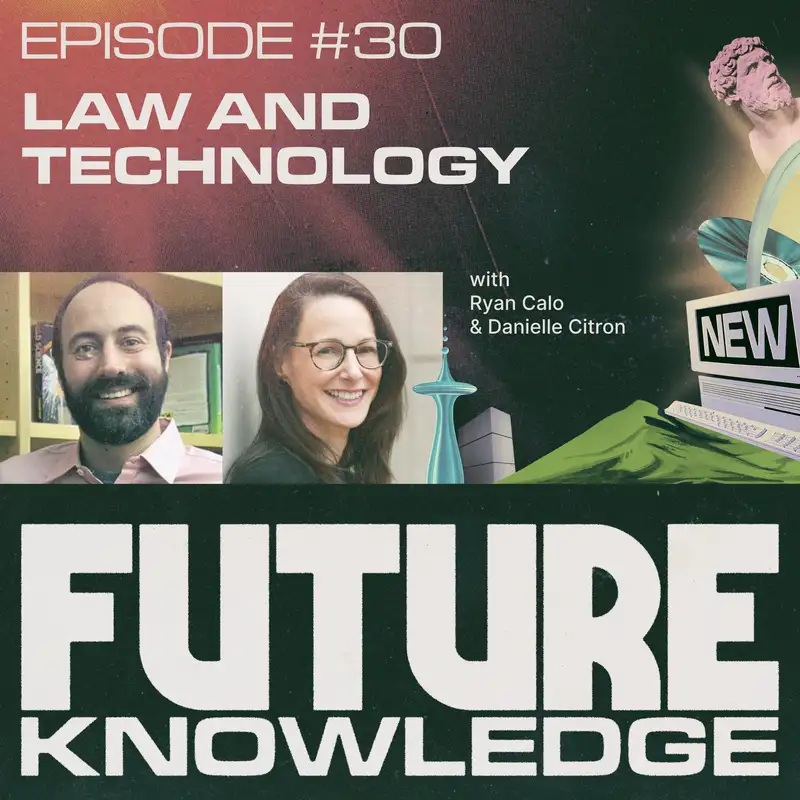
Law and Technology
Download MP3[00:00:14] Chris Freeland: New technologies tend to move faster than our ability to understand them and definitely faster than our ability to regulate them. You can see it with things like facial recognition being used in the real world before there are clear rules in place, or generative AI already reshaping how we create and share information while the policies are still catching up.
[00:00:34] So the pattern is pretty familiar. We're reacting instead of shaping, defending rights instead of defining them. If law is supposed to guide technology toward human flourishing, what happens when it's always one step behind? Hi everyone. I'm Chris Freeland and I'm a librarian at the Internet Archive.
[00:00:51] Welcome to today's book Talk in Law and Technology. Ryan Calo offers a clear and methodical way to think about these challenges, not by chasing each new technology, but by building a consistent framework for analyzing and governing them. Ryan will be in conversation today with Legal Scholar Danielle Citron.
[00:01:08] Here to introduce our speakers and to set the stage for today's discussion is Dave Hansen, the Executive Director of Authors Alliance.
[00:01:17] Dave Hansen: Hi everyone. Welcome back. It's great to do another book talk. So, as Chris said, I'm Dave Hansen, Executive Director of Authors Alliance, and so the topic of this book is, is really close to the heart of the things that Authors Alliance cares about.
[00:01:31] I'm really pleased to be able to help facilitate and co-host this talk today. So with that, I and I introduce our speakers. First, I wanna introduce Danielle Citron, who is the Jefferson Scholars Foundation. Schneck Distinguished Professor of law at the University of Virginia School of Law, where she writes and teaches about a wide variety of things, privacy, free expressions, civil rights.
[00:01:56] She is the author of a few books. One of 'em, the one I think I know her best for is Hate Crimes and Cyberspace. She's done a lot of work on, privacy and hate crimes and sort of how technology affects. Privacy online and she will be moderating the talk today in conversation with Ryan Calo, who is the Virginia Apprentice BLO professor at the University of Washington in law, computer science, and information science.
[00:02:25] And that kind of combo is pretty unique and I think you'll see that come through in sort of the book and how Ryan. Approaches the issues that he's addressing here. His work has appeared in a lot of different high profile law reviews that you have probably seen. California Law Review, Columbia Law Review.
[00:02:43] He's pretty well known nationally on several really important issues, including artificial intelligence in the law. He gave what I thought was some fantastic testimony. I think it was last year or maybe the year before on privacy and artificial intelligence and the need to think about
[00:03:00] National approaches to regulation of AI in relation to privacy concerns. But today we are here to have him talk to us about his recent book. Law and technology published by Oxford University Press.
[00:03:17] Danielle Citron: Thank Dave. Thank you so much for that.
[00:03:19] And I, I just thought before we begin, I just wanted to double down on, professor Kalo as a Renaissance person who is lawyer. Philosopher, computer scientist and information scientist who is our teacher, and helps all of us think about privacy, automation, robotics, and so much more. And so it is a real joy to be here together to talk about this magnificent book, which everyone should get, law and technology and methodological approach.
[00:03:49] So let's begin. Ryan, tell us what brought you to this project? Like why write this book? Can you talk to us a bit about that?
[00:03:56] Ryan Calo: Danielle, thank you so much for doing this. I really appreciate it a lot, Technology is such an incredibly important social fact and it just gets more important year by year, and there is a whole robust but still burgeoning literature around, you know what law and society's role is in channeling technology toward human flourishing.
[00:04:21] But there really hasn't been a book. That has tried to capture what it is that we do when we do law and technology. I, I remember looking around at some point to see, you know, maybe to recommend to an a student or a new entrant to the field, you know, what could you really read that would give you a sense of what we all do when we do law and technology.
[00:04:44] Gosh, I had to go back to 1973 and Lawrence Tribe and channeling Technology through law, which was a book about setting up the Office of Technology Assessment, which has since been defunded in the 1990s, and the so-called Gingrich. Revolution. I mean obviously there are books that we all have all read like your books and Code by Lessig and the future of the internet buys the train and so on.
[00:05:11] But those books are not primarily concerned with the question of what is law's role in technology in society?
[00:05:20] Danielle Citron: We often like dive in and presume. So many things. A what we mean by technology and then law. So would it be okay to start with a definition of when you use the concept of technology, what precisely are you talking about?
[00:05:35] Ryan Calo: Yeah, so it's not a particularly thick book, but I gotta say that I did a lot of reading for it, and one of the things that I read was the philosophy of technology and how people have sought to define technology over the years. You know, a lot of the definitions of technology, for example, by Alo Jaque, ALO, famously and Mumford and others in the early days of philosophy of technology, they really defined technology as just any practical application of science.
[00:06:06] And it included not just technology like we think of as you know, for example, a robot, but it also encompass techniques. Ways of doing that were derived from scientific inquiry. So for purposes of this book though, I really wanted to lean into the thinness, the materiality of technology, because I think it is that very thinness that drives some of the interesting legal puzzles.
[00:06:32] Mm-hmm. So I end up defining technology as basically digital or physical artifacts. That have been created in order to extend you in affordances. And so it's really about making a thing, a system or an object that is meant to change what people can do. And it is really that definition that which, you know, appears in the literature also, but really thinks about technology as really artifacts and systems that have at least a digital presence, if not a physical.
[00:07:09] Danielle Citron: Because that definition is so practical in the sense that we can sense it or interact with systems that change how we move through the world and change our abilities. You know, it seems that law has a tough time. So talk to us a bit about why law has a hard time contemplating addressing combating problems that arise from things that, as you said so well, that we wrestle with all the time.
[00:07:34] We know it change how we live and our opportunities.
[00:07:38] Ryan Calo: I mean, so there's a few things I talk about in the book, but let me focus in on one, which is that over the years I've observed that technology has this way of making a kind of shell game. Of human responsibility and you, you know, Danielle, like the Shell game where you have three cups and there's a little ball and you don't know which one it is, and you guess wrong and you lose $20 or whatever it is.
[00:08:00] But the idea is that we do so much with and through technology and every time we participate in the world of work, of love, of, you know, friendship, whatever it happens to be, of creativity, and we do that with a technology or through a technology. There are a lot of people's decisions and politics to borrow from Langdon Winter and perspectives and desires and intentions that are present in the technology but are not necessarily visible or legible.
[00:08:34] And one of the things the law struggles with deeply is the ability to attribute responsibility accurately across the social technical system. The law has this tendency, which is. Pretty well documented of focusing in on the person who was there, right? The person using the technology, the person hurt by the technology rather than all the people and all the decisions that went into architecting that system.
[00:09:06] Danielle Citron: Right? And is that difficulty that we have, which is lawmakers, right? And courts. Is there difficulty that the designers themselves have in wrestling with even or conceiving their own legal responsibilities, like the designers of these tools? Right? They're unseen. They're not legible often to lawmakers.
[00:09:26] What about the designers themselves? Do they fall into traps that make law not present in some sense, in their own minds?
[00:09:34] Ryan Calo: Oh, absolutely. Right. I mean, we saw this for decades where privacy and security would become an afterthought. I just want my system to work. I just want it to be frictionless. I just want lots of people to use it.
[00:09:48] Oh, and then later on, let's bolt on security. And by the way, when I say like developers, I mean at the highest levels. I mean Google, I mean the Pentagon, right? We were using drones for a very long time in the US military. Uh. Sending back the video feed to the soldiers in the clear so that enemies were able to actually snoop in on our own, our military drones until we went to an encryption.
[00:10:15] And even then, for example, Iranians were able to spoof A GPS and cause our military grade millions of dollars technology to think that it was. Higher than it was and cause it to land. And so, yeah. Something I think about a lot is that if developers thought more about legal liability, about societal impact more upfront, maybe we wouldn't have a many, many million dollar jury verdict against meta the other day for predicting kids to social media.
[00:10:50] Danielle Citron: Yeah. And so. You have some amazing examples in the book about how law really makes a hay of a technological, like harms and problems. Can you describe some of those examples? I'm thinking of the Nevada one.
[00:11:05] Ryan Calo: The Nevada one? Yeah. Yeah. So let me give you a couple. Yeah, we can, you know, we were just talking about the way that technology kind of makes a shell game of human responsibility.
[00:11:14] And, and, and I'll give you an example of that first, right? And then we'll go to Nova. I hear it's lovely this time of year there was this famous fatality in Arizona involving an Uber driverless car. And what struck me about that instance. Was that here you have Uber's driverless car and they've hired a woman to monitor it for a long shift, and at some point she ceases to pay attention, and at the same time that she ceases to pay attention, a woman is crossing against a crosswalk and the car detects her, but fails to stop and runs into and kills this woman in Arizona and the Arizona authorities charged.
[00:12:02] The woman who worked for Uber criminally for basically, you know, negligent homicide, and it was quite a tragic thing. And yes, there is blame there, right? I mean, she was hired to monitor the car. She wasn't paying attention. That's part of how the accident occurred. But at the same time, Danielle, the Department of Transportation, did an audit of Uber and its safety culture.
[00:12:27] They found it lacking, and one of the observations that they made was that Uber had built their driverless car on top of a contemporary Volvo, which has built into it automatic collision detection and avoidance, and Uber turned that off. They turned that off because they were trying to test their own systems and make sure to validate their own systems, right?
[00:12:52] Had they not turned that off, and this is something the Department of Transportation observed, maybe this accident wouldn't have occurred. Now, when we think about this for a moment, this woman who is charged criminally, she made a terrible call, right? You can sort of see this tragic video of her face from inside of the 'cause.
[00:13:09] The car has a gas cam. And she's driving. She's paying attention, paying attention. At some point she goes and over here and, and looks down at something, maybe her phone, and at the last minute she looks up and tries to take control of the vehicle and tragically is unable to do so. That was a split second decision in the moment.
[00:13:26] It was a decision born out of being in this car that drives itself for whatever number of hours, but the decision to turn off. Volvo's own redundant safety feature. How did that decision happen? That happened in some boardroom. It happened over a series of phone calls, over a series of emails. If you had all the time in the world to think through what the ramifications of that action were, right?
[00:13:51] Another way that law finds technology so hard is that. Oftentimes the unit of analysis, the thing that we're targeting when we target technology as a regulatory object is whatever industry happens to have put before the legislature. Right. I remember testifying before the US Senate judiciary about drones.
[00:14:14] The whole time that I was testifying, there was like this innocuous looking quadr copter
[00:14:19] that can only stay up in the air for 15 minutes and has two cameras. Meanwhile, I just saw a demo of a new generation police drone that can stay up for 60 minutes, has radar, night vision, all kinds of things, right?
[00:14:31] But the lawmakers at the time wrote rules about. The object of analysis they had before it. Right? Similarly with Nevada. Nevada passed pioneering driverless car legislation years and years ago based on a model that was brought to it by Google lobbyists. This is well known. And so basically Google lobbyists said You could be really innovative Nevada.
[00:14:52] You can be the first state to have allowed driverless cars under certain conditions, and here's how you should define them, and here's what you should do. And Nevada went along and the governor signed the law and it was quite a big deal. But as it got publicity, suddenly other stakeholders other than Google came to be aware of it, they realized that the definition used by Nevada for a driverless car was anytime a computer substitute or for what a human driver would do.
[00:15:18] And of course. All of the luxury vehicles like Lexus and Mercedes and many, many vehicles, many contemporary vehicles said, well, wait a second, wait a second. Our computer substitute for lots of things. We have auto lane correction, adaptive cruise control, self parking, you know, even antilock brakes. When you hit antilock brakes, like when you hit the brakes.
[00:15:39] It's really a suggestion to the vehicle that it slowed down and it decides whether or not that would be appropriate. And so anyway, there was such an outcry about only thinking about. Driverless cars from the model presented by one company, they ended up having to repeal this law a year later and rewrite it.
[00:15:57] And we were part of the process of rewriting it over at the time when I was at Stanford. So yes, I mean these are pitfalls that are well documented and there's many, many examples.
[00:16:07] Danielle Citron: So what's interesting about the first, and I think it ties to the second example, is that law is ignoring, and you said. We held responsible, the human being, and there was a tragedy there, but we missed the fact that the safety culture was, they made a decision to in favor of their agenda over safety and ignored safety.
[00:16:28] And we see this with meta in ways that are even more flagrant with the jury decision and the New Mexico case, right? Knowing well from whistleblowers that we have a real safety problem with kids and harm, and yet making a decision. To wanna make money, so we're not gonna make things safer. Right. So in some sense it's the choices laws making is to not see the problem in favor of industry.
[00:16:55] Right. And I know that's a longstanding, you need to talk to my class about this, that, you know, tort law as it has developed. Has moved from wanting to favor industry to let it flourish. And then finally we see harm when there's just too much harm. And were we in this moment that now we're seeing some reckoning, right?
[00:17:15] That law. Is gonna see the problems after ignoring them for like 25 to 30 years. Right. And erring on the side of no liability or blinders to the liability. For all the reasons that you talked about in the book, the different pathologies about, and myths around these, you know, technologies.
[00:17:33] Ryan Calo: Yeah.
[00:17:33] Well look, I mean, when we first started out there was a kind of Cassandra syndrome where. People were sounding all manner of alarms and they were falling. And it was as if, especially government thought that information communication technology was the first multi-billion dollar human activity without significant externalities.
[00:17:56] But there has been a tech lash, there has been a lot of recognition that these technologies, of course, have wonderful, amazing benefits, but also. Have harms, harms that are to the individual that you have documented in your work more than anyone, to groups, to particular identifiable groups, especially the marginalized and to society as a whole.
[00:18:18] Now, I think that recognition is super helpful on a number of levels, one of which is a, you know, people feel seen, people are being made whole in the ways that tech, you know, the ways that law is capable of making people whole. But I also. Have to believe that the folks that are designing contemporary systems are looking at this meta decision, are looking at societal backlash, are looking at Europe's regulation and so on, and perhaps thinking about how to design these technologies, both to try to.
[00:18:54] Identify and mitigate harm in the outset, and for example, with red teaming of ai, but also to help convince everyone that the technology really does benefit them. And let me just give you a quick example. It's not in the book of it. One of the things I think a lot about is agent ai, okay? Mm-hmm. Now, if you think about agent AI and how it differs from previous and constituent technologies, it is that ability to proactively accomplish goals through reasoning through.
[00:19:20] Multiple iterative steps towards a particular goal, and then ultimately, possibly to effectuate something real in the world, whether it's embodied through robotics. You know, I, I like to think of Roomba as an early example of Aden AI that you just is assigned to clean your house and it uses models and other things to do that, or to make a stock trade or buy a book for you.
[00:19:40] Whatever happens.
[00:19:41] Well, you know, what kind of liability will. Agent AI be subject to. And I think it's largely a function of two things. One is, can we say what is reasonable and unreasonable in agent ai? Like can we use protocols or other kinds of best practices in order to come up with a way to mitigate those harms at the outset?
[00:20:04] And the second thing is. What is the social and societal value? If all Agen AI does is perpetuate this trend of replacing compensated labor, paid labor with automation, putting people out of jobs, displacing people outta jobs, and aggregating wealth more and more to the top? Well, that doesn't sound like it's terribly society beneficial, right?
[00:20:25] But if a gen AI instead is put to the task of. How big people with all the myriad uncompensated labor, all the shadow work that we have to do in society for generations, and helping you not have to fill out those forms or talk to those people on the phone. The second thing is people that develop a Gentech ai, if they can make a case that this is broadly societally beneficial.
[00:20:52] And that there are adequate protections in place so that reasonable care could be asserted with a Gentech ai. Well, that militates in favor of using a fault negligence standard rather than, for example, strict liability, which would hold you responsible regardless of the level of care that you use. And so there is this sort.
[00:21:12] Dialectical process between law and technology where the designers can get more favorable legal treatment by designing a certain way and they haven't been doing that. Right. And also where law will respond to the state of the technology in setting the kinds of liability standards.
[00:21:27] Danielle Citron: Yeah. Yeah. And so for our audience.
[00:21:30] Just to unpack what you just did, Ryan, which is you took a technology agent, ai, you helped define it and set the parameters of what you were talking about. You then imagine the potential, both from businesses and individuals, potential possibilities of harm, but also it's value, how it changes the way we move the world, our affordances, as you would say.
[00:21:51] Yeah. Right. And then you said, listen. We wanna make this, we wanna ensure that it is helping us flourish. That our social welfare for all of us are beneficial. We don't wanna ignore the benefits. Right. You're not letting us ignore it. 'cause I'm always quick to be like, forget that. Right. And you know, in using your tools, I know it was very quick, but you're helping us see how having clarity around in your book as you do, what the technology specifically is and how it operates, how it's changing the world around us.
[00:22:23] What it's doing to society and then thinking about law's potential role and what our normative commitments are. Right is like your agenda in some sense. No.
[00:22:35] Ryan Calo: Yeah, it really is. Yeah,
[00:22:36] Danielle Citron: because I have a question. Ready. So many people use the term ai, like it's self-explanatory when it's many different things, right?
[00:22:44] Like, do you have a framework for all of ai? You gave us a great example. We were like, we're gonna talk about this one possibility of automation that lets. Automated Tool Act on your behalf, With your instructions? Like do you find that question or the proposition that there's a way to solve all of AI hard, right?
[00:23:03] What do you do to those folks? like, how do we solve all of AI Professor kalo? You know what I mean? Maybe help us, walk us through that and whether you have optimism about addressing it. That is the different types of automated systems.
[00:23:17] Ryan Calo: I do, I do. Again, you know, all, all I'm proposing in this book is a methodical approach to emerging technology, but as I see the central contribution it is to, to lay out a step-by-step, methodical approach to any given, to analyzing any given technology from a legal perspective.
[00:23:36] And if you take ai, gosh, I've been writing about AI for a long, long now, and the truth is, is everybody knows that AI is not like a thing. Like a train or even a train system. It is instead a set of techniques that are aimed at approximating some aspect of human cognition using machines. One of the key challenges of legal analysis, whether by scholars like you and I, or frankly by a legislature or a core, is to select the proper unit of analysis.
[00:24:08] That's why when I started talking about agen ai, I wanted to define the technology and especially, yeah. To differentiate it from previous and constituent technologies because it is that change in affordances, a change in what people can do that the law's gonna care about. Within AI as an umbrella concept, you might have something like pattern recognition, the ability to pick up on patterns and draw inferences from data, and that's something that we know.
[00:24:35] Machine learning can do really well, right? You irrespective of whether it's ent, it just, you train a model and it draws inferences. Well, you know, the fact that kind of predictive machine learning AI can take nonsensitive data or impersonal data or data that seems innocuous or public and derive things about people that are quite sensitive and quite intimate, well, that poses a challenge, for example.
[00:25:03] For privacy law, does privacy laws typically draw distinctions between sensitive and nonsensitive health and not health? Personal not personal? Mm. And as those distinctions come to collapse because of the predictive abilities of ai, well, it's time to revisit them and they're the normative sort of baseline is, well, we made a set of promises about rights and responsibilities and we can no longer.
[00:25:28] Um, uh, we can no longer carry through on them. And because there's been this change to affordances, we're not, and so now new legislation, like the legislation in Washington.
[00:25:37] Danielle Citron: Yeah.
[00:25:38] Ryan Calo: New legislation tends to say, Hey, we're talking about sensitive health information. Including that you've derived from not, you know what I mean?
[00:25:46] And so all sudden we've had these changes in, in these things.
[00:25:49] Danielle Citron: whereas something like GenAI, which is still very much emerging, we might take a different path, not ask about what the status quo has been and how do we restore society to the status quo before adjunct ai. But we can take this transformative technology as an invitation to inventory our values.
[00:26:09] Yeah,
[00:26:10] Ryan Calo: and ask ourselves what is possible now that wasn't before. And so when I reference Shadow work, the idea that for generations, institutions, you know, an industry and government have devolved labor tasks to individuals such that our lives are. Replete with situations where we just have to do busy work for which we're not compensated.
[00:26:32] That is a terrible generational trend and there's a huge literature around it. What if IC AI could reverse that generational trend? Right? That's what's exciting to me. And then what that is law's role in channeling that technology towards the public interest. It may be something like regulation where you have requirements, or it could just be about setting the proper standard of liability.
[00:26:54] To negligence instead of strict liability if they can carry through on that promise.
[00:26:59] Danielle Citron: And what's so to, just to emphasize for our audience that move that you made that I think is so, has always been creative and pushed. So Ryan and I write together and we wrote a piece called the Automated Administrative State.
[00:27:11] And in doing that, you know, we were examining mistakes that we were making in public benefit systems and others. Were depriving us of important commitments in law, but you pushed us and always pushed all of us in our work is to ask not only the commitments that we lose, right, that we can't honor. That technology changes our affordances so that it means that we are not living up to the commitments of due process or rulemaking or whatever it may be.
[00:27:35] You also asked us, listen, technology is an opportunity. You said to us as we wrote right to inventory new values and to honor them. And let's use this opportunity of automation to make it easier to have translation in the courtroom, right? Like you are offering and just as you're doing here with agen ai, you're saying, look, it's gonna, there are gonna be problems, right?
[00:27:57] And there may be that there are affordances that change and challenge our already commitments, but you're also asking us to imagine how technology might. Enhance values that we don't yet have on the table, and that's a really important, I know I'm restating what you said really well, but I think it's important for everyone.
[00:28:17] To recognize. That's a very kalos contribution for us to think about. And this is Ryan Calo, not Maryanne Kalo, who's also Professor Dr. Kalo. Your mom would like that, right? I mean, that is an important contribution that you have nudged us and nudged lawmakers as you advise the Senate, the House state lawmakers to do.
[00:28:37] Ryan Calo: Yeah, I mean, after our article, which by the way we just noticed, was cited by the Supreme Court of Israel in a case about automated decision making the other day, I wrote a follow up paper on my own in Duke Law Journal that is about the prospect of using computer modeling to improve policymaking and observing that most sophisticated institutions, be they the military or industry.
[00:29:03] You know, use sophisticated computer modeling in order to try to anticipate possible scenarios and why isn't the government, you know, doing more of that? Right? And I've acknowledged that there are pitfalls and concerns around that and so on. But yeah, I mean, I really do. I think that's something that we lost in America.
[00:29:20] But I mentioned before Lawrence Tribe's book about the Office of Technology Assessment know for 20 years there was this big, you know, hundreds of people in many disciplines. At the OTA advising Congress on how to use technology to promote the public interest in addition to putting around safeguards.
[00:29:40] And it was defunded in the 1990s at the dawn of the commercial internet. And I always, but yet for years leading up to that, and the reason I think it was defunded because it was so impactful in Congress's thinking about how do we use technologies to promote. Human good, like genetic modification or uh, nuclear power or even databases.
[00:30:02] Right? And I always think to myself, what would the internet look like? Had we had an OTA at its commercial inception, what would AI policy look like? Had we had an OTA and you know, I think we need to get back to that. I think Europe is, is better at it. And so because it's not a. People think of the, something like this.
[00:30:22] Oh, this is like precautionary principle. You're gonna hamper innovation. It's gonna be bad, but no, no. It's society's role to decide the path of technology and you know who it benefits and who it doesn't. That's something that we collectively should have agency just as we do with other social facts in the world.
[00:30:41] Danielle Citron: So you have this amazing example in the book about communities that are more thoughtful about the technologies that they use and have in their communities. And the Amish is an example that you use and I know you use it in class, but we have a lot to learn from them. So might you talk, just share that, with our audience.
[00:31:00] Ryan Calo: Yeah. So, you know, I teach undergraduates as part of my role in information science. For example, in computer science, I teach undergraduates tech policy and ethics. And I always begin by assigning this great paper by James Wetmore about how the Amish think about whether to use technology because the Amish don't do what American society writ large does, which is just accept technological change.
[00:31:27] And then think of our role is to scramble around to adapt to the resulting disruption. The Amish will only incorporate a technology if it is consistent with their values of community and service. Sometimes they'll incorporate a version of technology, adapt version of technology that is less efficient or older because it is more consistent.
[00:31:47] So for example, the Amish. Sell, produce and furniture and they need to be able to call you to tell you when your vegetables or your chair's ready. And so they do have phones, but the phones typically are in the middle of the town square and they're like a payphone that you have to leave your house in order to use it to transact because the concern is that a phone in the home would take you away from community.
[00:32:11] Now, do I think we should. I'll be using horses and buggies. Oh,
[00:32:15] no. Right. but what I'm trying to do with my students and the book is to just shock us, like loose from this idea that invariably technology will just. Progress, other social effects change, you know, technology dances. And that somehow our role is to just now, okay, well now there's augmented reality, now there's facial recognition to took example at the top.
[00:32:37] What do we do about that?
[00:32:39] Danielle Citron: some folks like our good friend. Woodrow Hartzog would like to see bands of things like facial recognition because they're so pernicious. But I don't go so far as that. But at the same time, like particular jurisdiction, be it Boston or Massachusetts or you know, whatever, wants to have really strong rules around that.
[00:32:59] Ryan Calo: Well, that's the beauty of our Federalist system, that communities can experiment with different tolerances for the technology.
[00:33:06] Danielle Citron: And might do, we have some steps stored, like a tech assessment. We got rid of it, right? But Office of Tech assessment with the digital service, like in the executive branch and like Chief Technologist in CFPB, I'm thinking of rie, Meyer and Chief Technologist.
[00:33:20] In the FTC and the roles of chief technologists in the state AGS offices, right? That these were steps towards bringing tech assessment in-house that is in the role of the law enforcer, right? And some of that within Congress, right? The tech fellows know the congressional tech fellows, and we've retreated, right?
[00:33:39] Like we've let a lot of people go. How can we reclaim the energy and the vision of your book? Which is to bring tech assessment, a frank, clear-eyed view of the technology, its challenges and kind of normative commitments. And then think about what law could do in advance, as you're saying.
[00:33:59] How do we get back to that in some ways that it might require law, To do that, to have thoughts about how we might do that.
[00:34:06] Ryan Calo: I really think that this is a question of political economy and like where there's a will, there's a way. I mean, although the OTA itself was defunded, we kept the Office of Science and technology policy within the White House.
[00:34:18] Certain kinds of agencies like the OIA and OMB have taken over some of these roles. The Congressional Research Service advises Congress today, but I think the most important development, Danielle, is the one that you identified just now. Also in your work on the importance of state ags to privacy. I mean, of all your predictions that have come true and there have been many, that one seems to be like the most powerful at the moment because the state ags are able to bring a kind of accountability with law that has perhaps been lacking, but it's no coincidence that the Federal Trade Commission.
[00:34:57] Before and under Elina Kahn staffed up on technologists. Some of our tech policy lab graduates were the first technologists at the fd. The, there's no question that all of the proposed legislation, much of which has not actually managed to run the whole gauntlet, comes from the fact that of Tech Congress and all of the engineers and the people have done through Tech Congress and so on.
[00:35:19] Right. And so I do think that having a lot of expert, and not only that by the way, but also just. The plaintiff's bar is so connected now to technologists that they can bring as expert witnesses. It's impossible to bring these cases, these class action cases without having a technical expert there. So I see very positive signs, but I mean, you know, there's no substitute in my view to having something like the OTA.
[00:35:51] Which is a lot of capacity, very interdisciplinary, and it exists too. Help what is supposed to be our most powerful branch of government, which is Congress, which is supposed to be writing all the laws that the executive then executes. And so we do have a bit of a, a problem of just a generally broken system.
[00:36:13] Right. But I am certainly encouraged, especially at the state level and courts. I mean, I'm encouraged and I hope others are too, by some of the Supreme Court decisions about the Fourth Amendment in technology in the last. I think that that cases like Carpenter and Jones in particular probably should be having,
[00:36:31] Danielle Citron: Hey, RI, like my phone matters.
[00:36:33] Ryan Calo: Yeah. These are big. So anyway, it's a longwinded way of saying that. I don't think there's any substitute for refunding OTA, but I'm encouraged by the signs I'm seeing at the local level
[00:36:43] Dave Hansen: because we're on the topic of Congress and OSTP. You outline some really clear methodologies for like assessment and kind of finding path forward, but there was one question here that I thought was a good one to start with.
[00:36:57] What's one principle or approach that you believe lawmakers should adopt now to better govern technologies that we don't fully understand?
[00:37:06] Danielle Citron: Well, that's a great question.
[00:37:08] Ryan Calo: I think that one of the most important things for lawmakers to think about at a high level. Is that technology often poses as inevitable when in fact it's deeply contingent time.
[00:37:22] And again, you see policymakers reacting to whatever the market or industry has put before them, rather than thinking through how does this technology or set of technologies change human affordances. And I do think that drone surveillance is a great example of that. The bills that came out of that Senate judiciary.
[00:37:42] Hearing, which were emulated by the states specifically defined drones. In accordance with the F Federal Aviation Administration's definition and did not include many, many new techniques to use mobile aerial surveillance against the population. Nor do they really, were they calibrated to the kinds of capabilities that we see today in contemporary drugs, right?
[00:38:07] And so I think it's very important for policymakers to remember. You know, just because something has been put before you doesn't mean that's the only instantiation. Another quick example is robotic delivery. You know, those little carts with the six wheels that, you know, deliver things on campuses like Starship.
[00:38:24] You know, Starship went around and went to a bunch of states and said the same thing as Google did in Nevada and said, oh, we need to be clear that we can use this on the sidewalks. Once you write a law about robotic delivery, it's so important. And the states were like, oh yeah, that sounds really important.
[00:38:38] And then they passed these laws that defined robot delivery as. 90 pounds, six wheels, this kinds of thing. Exactly. The technology that was being used by the leading when in fact there might be myriad ways that robotics can be helpful in last mile, you know, transporting delivery. So that's one of the key things I think that lawmakers have to keep in mind.
[00:38:58] Dave Hansen: So quite a few questions about ai and I know we talked about this a little bit, but one that I wanted to just poke on a little bit more, because you talk about this quite a bit in the book, is the speed of AI or the perceived speed and like, you know, just the trajectory. And I think. For a lot of folks, they do feel like, wow, this is moving very fast.
[00:39:17] And in the book you talk about this idea of not just the inevitability, but the pace of change and how to think about that. So could you talk a little bit about just how to think about like the rate of change and regulation?
[00:39:29] Ryan Calo: I mean, anytime you go to like a dinner party or a cocktail party and you say like, I do law in technology, like the first thing that someone says to you is like, well, that must be hard because technology's so fast and, and law is so slow.
[00:39:41] And there's truth to that. I mean, it's not a, it's a smart thing to say. It's, it's, there's truth to that, but I think it's dramatically overstated. And I think that if it's also potentially a recipe for paralysis, especially alongside the insight that. You can't know in advance the impact technology will have on society.
[00:40:02] So if you intervene early, you're gonna make a mistake and it's not gonna be wise, right? Plus the idea that you don't wanna kill the goose that lays the golden egg. And so all of these things act as a kind of force field around technology. But my observation in the book is simply that there are so many things that move really fast.
[00:40:20] I mean, you know, in a 10 year period. The United States got so upset about drinking. We passed a constitutional amendment to stop people from drinking, which do you know how hard it is to pass the constitutional amendment? And 10 years later we got so upset about not drinking, that we passed another constitutional amendment in order to allow us to drink.
[00:40:40] But, and even faster than that, we had to rewrite American labor laws. To encourage women to enter the labor force during World War II when soldiers were fighting abroad, and then we had to rewrite them again two years later when those soldiers came back and passed. Things like the GI Bill and the like, right?
[00:40:59] So sometimes just to paraphrase, Ferris Bueller, life comes at, you're kind of fast, so I, I'm not sure why technology uniquely has this sort of veneer of unregular ability due to its pace instantly in the book, I also use examples. Like the space treaty where in a very short period of time we were able to come up with a international framework for space within years of the first satellite being launched.
[00:41:25] So when we're motivated to do so, we can also move pretty fast.
[00:41:29] Danielle Citron: Totally. And companies want us to think we can't, right. As you're saying, laying the golden egg, they're like. You can't do that. We need to make lots of money and we don't care about the externalities. Right. They would love us to think so.
[00:41:42] Ryan Calo: It's hard.
[00:41:43] I know, because if you look at the top companies by market cap in the United States, and you look at 'em today and you look at 'em 10 years ago, 20 years ago, eight of them are technology companies, like these are the largest valued companies in the history of America. Right. And so it, it's scary
[00:41:59] Danielle Citron: and in law we made a choice not to regulate them in many respects.
[00:42:04] Ryan Calo: Absolutely.
[00:42:04] Danielle Citron: For the very reason you just stated, oh, it's too hard. We can't, but you were like, we amended the constitution twice.
[00:42:12] Ryan Calo: Often a matter of political will rather than a matter of feasibility, Dave. And I think sometimes, you know, those things get conflated.
[00:42:20] Dave Hansen: I think I have time for one last one, and maybe this is a little bit down in the weeds of legal particulars, but you mentioned the Amish.
[00:42:27] The book talks about like these Luddite communities. I teach a class at the high school at UNC and my students were telling me about the Luddites in New York City who have used cell phones. And so I guess one of the questions is like how to think about the scale of potential regulation or lawmaking or policy.
[00:42:46] You know, there are lots of things that happen in dc. There are lots of things that happen at the state level. There's some things that happen in kind of more insular Amish communities, right? And one kind of glib response to this is like, if you don't like the technology, don't use it. But obviously it has broader effects.
[00:43:01] And so how do you kind of think about where those regulation or policy needs to live across the spectrum?
[00:43:07] Ryan Calo: Yeah, I mean, so just very quickly, like your city sets up, uh, ubiquitous cameras with facial recognition. Oh, just don't use them. You know what I mean? Like what? But let's make a, I think that one of the sort of issues that you see is that the policy discussions don't recognize the full range of options that policy makers have under a complex legal system like our own and indeed step four of my methodical approach.
[00:43:37] It has to do with mapping out the possible sets of interventions. Once you do that, you see that it's a false dichotomy to say that you've gotta ban something everywhere versus just let people innovate without permission, so-called permissionless innovation, because we have, for example, federalism. So one state could decide one way, or even a local municipality could decide one way and see how it works out.
[00:43:58] The second thing is that. We miss the idea that there's rules, but there's also standards. It seems odd to say, oh, law can't keep up with technology. When the Federal Trade Commission, their mandate is to police against unfair and deceptive practice. In what universe does unfair and deceptive practice as a broad standard not able to keep up with technology?
[00:44:21] It sure is, and under Lena Khan, the FTC pursued dark patterns and many other things that we've been agitating. For, for years. So, you know, I think understanding a full range of options under a complex legal system helps to delay some of those concerns that we're gonna be overdoing it or that, you know, we either have to innovate or ban.
[00:44:42] Dave Hansen: Well, I wanna thank you both. This was such a great conversation
[00:44:47] Chris Freeland: Big thank you to Ryan and to Danielle for a fascinating conversation to Dave Hanson and Authors Alliance for facilitating and co-hosting these sessions.
[00:44:55] Thanks all. Have a great day.
[00:44:57] Thanks for joining us on this journey into the future of knowledge. Be sure to follow the show. New episodes, drop every other Wednesday with bold ideas, fresh insights, and the voices shaping tomorrow.