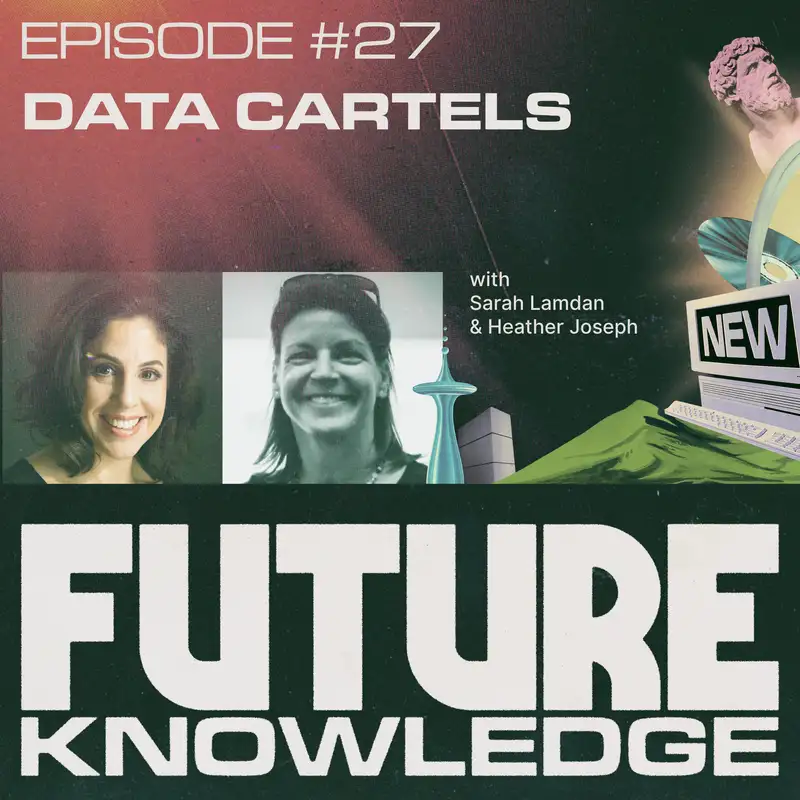
Data Cartels
Download MP3[00:00:15] Chris Freeland: In our digital world, data is power. And guess what? Companies know that, especially those that hoard our data and use intimidation, aggression, and force to maintain influence and control. So what can we do about it? Hi everyone. I'm Chris Freeland and I'm a librarian at the Internet Archive in Data Cartels author Sarah Lamdan brings us into the unregulated underworld of these information hoarding businesses.
[00:00:40] These data cartels. Demonstrating how the entity is mining, commodifying, and selling our data, perpetuate social inequalities and threaten the democratic sharing of knowledge. Chatting with Sarah today will be Heather Joseph, the Executive Director of SPARC. That's the Scholarly Publishing and Academic Resources Coalition.
[00:01:01] Heather is an outspoken advocate for open data, open access, and equitable knowledge sharing.
[00:01:07] It's now my pleasure to welcome Dave Hansen. He's gonna set the stage for today's discussion and introduce our speaker.
[00:01:13]
[00:01:15] Dave Hansen: Thank you Chris. So, hi everyone. I'm Dave Hansen, executive Director of Authors Alliance. I am so happy that we are able to co-sponsor this book, talk with Sarah and with Heather. So I'm gonna do, just two brief introductions and then get out of the way so that we can hear from, Heather and Sarah.
[00:01:35] So Heather Joseph is the Executive Director of SPARC, which is a nonprofit organization that promotes sharing knowledge as a human right. Under her leadership, SPARC advocates for practices and policies to make our systems of research and education more open and equitable. SPARC's efforts have resulted in policies ranging from securing tens of millions of dollars to support free open college textbooks to, and huge success on this.
[00:02:01] This next piece, the White House policy requiring open access to all US federally funded research. Hard to overstate how important that is. Heather is deeply engaged in the global open knowledge community and serves on the board of directors of organizations ranging from the Arcadia Fund to public resource.
[00:02:19] And our author for today who you've all been waiting to hear from is Sarah Lambda. Dara is a professor of law at the City, university of New York's School of Law. She also has a master's degree in library science and legal information management. And her research focuses on information law and policy.
[00:02:39] I'm gonna hand it over to you, Heather.
[00:02:42] Heather Joseph: Thanks Dave, and welcome Sarah. So glad to be here chatting with you about your book.
[00:02:47] Sarah Lamdan: I'm so happy to be here
[00:02:49] Heather Joseph: It's kind of nice. It feels like we're sort of Hmong family, you know, between the Authors Alliance's commitment to working with content creators to. Get their stuff out as broadly as possible, the internet archive, and then of course you and I who are sort of nested within the library community. It's nice to kind of be in communion with our people.
[00:03:07] Talking about your book today. Exactly.
[00:03:09] Sarah Lamdan: Yeah.
[00:03:10] Heather Joseph: And your book is both, it's kind of that best combination of both. Fascinating and urgently important. I think it is. You know what? Reading the book I was struck by. Just kind of thinking we're immersed in this work day-to-day in SPARC, right? Kind of working in the library community and paying attention to the commodification of knowledge in the companies who have, you know, really made that happen.
[00:03:35] But I was struck by thinking about, I wonder how many people actually know what's going on. And I think you writing this book really pulls back the curtain on something that I would imagine a lot of people are surprised. To know about, and I know you were even a bit surprised to, to kind of see what was going on, and I thought it might be really fun for people to hear how you kind of got into this topic.
[00:04:00] Right. How do you, you became aware that this massive change was taking place in a space where I think people felt safe. You go into a library, you're browsing through a, you know, an online database of journals. What could go wrong? So curious, Sarah, tell us a little bit about you and how you came, how you came upon this.
[00:04:20] Sarah Lamdan: Yeah, no, that's a great question and it's, it's true. The reason I wrote this book is because I learned. A lot of things that were very interesting and surprising to me as a librarian. And I thought, okay, if I'm just learning about these things, then I imagine a lot of other people don't know about them yet.
[00:04:39] And that's actually why I wrote the book. So to rewind to the start of kind of how I came across this information, because I don't have, I mean, I have an information science background and a law background, but I'm not, you know, I never worked in the tech industry. I mean, I help. Build Bloomberg Law, but that's not, that was more of a librarian role than a tech role.
[00:05:01] Heather Joseph: You might wanna come back to that. Yeah, I'm
[00:05:02] Sarah Lamdan: like, not as close as like, but yeah, that's, I actually write, I write about Bloomberg LP in the book too. 'cause I think it's really interesting 'cause the book is kind of like a walk down memory lane of all of the places I've been at. It talks about law libraries, it talks about academic information, it talks about financial data.
[00:05:19] And new. But yeah, I, so when I, in 2017, I was a law librarian like Dave. I came from a law library background and I'd worked in some law firms. I helped, you know, work on Bloomberg Law and then I was an academic law librarian and I, the main part of my job was training law students and helping faculty to use.
[00:05:41] Two major legal databases, Westlaw and Lexus. Those are the gold standard legal information companies in the United States, and they're kind of a duopoly. They're by far the most prominent, dominant legal information. I. Publishers and platforms
[00:05:56] Heather Joseph: and they're so rules of the trade, right? For Yeah, for awesome.
[00:05:59] So you have to have these things, right? Everybody's,
[00:06:01] Sarah Lamdan: exactly, exactly. Yeah. You cannot, there is no other system, set of system that judges court, legal scholars, researchers, law firms use, and some judges go as far as to require citations from Westlaw, Lexus. They won't, you know, they won't take other companies and other publisher citations like they're really.
[00:06:23] The gold standard is, is as a standard, as a gavel or robe. You know, there, there's Westlaw, Lexus. Yeah. And so my job, when I first started teaching or being a law librarian, there were paper resources. There was kind, you know, you go to bookshelves, but by the time it was 2017, I really felt like I was kind of a glorified Westlaw Lexus representative.
[00:06:44] Like really, I was just teaching those two products because they really had overrun legal information and. 17. The Trump administration had just come into power and ice and immigration and customs Enforcement was a big agency that was in the news a lot for controversial. And kind of problematic reasons, right?
[00:07:03] We were learning that ICE was being directed to separate families at the border and that children were being kept in some, some pretty horrible conditions at detention centers. And so ICE was in the news a lot and there was a lot of concern around what ICE was doing. And so a couple of tech reporters noticed that ICE was going to build an invasive surveillance data surveillance system.
[00:07:26] They were really, they were smart, they were intrepid and they requested, they, they made a FOIA request with ICE board, the list of tech companies that attended this, the, the informational investor day to learn how to participate in making the surveillance system. And two of the companies that had a lot of attendees at this investor day were Thomson Reuters and Lexus Nexus and.
[00:07:54] Thom Reuters is Westlaw's parent company and LexiNexis is Lexus law. And so I saw this news article and I saw kind of the signatures of these attendees, and I was really startled and confused because I. I didn't understand how Lexus and Westlaw would be doing ICE surveillance. Like I didn't understand what the rule would be and I was concerned as somebody who works at the city of University of New York, which has a big immigrant population, and a lot of my students go into immigration law, and I wondered what the implications of these companies working with ICER and giving data as an as a librarian.
[00:08:32] This all felt very uncomfortable to. And my colleague, so the person in the office next to me, another amazing law librarian named Yasmin Sokar Harker. It was uncomfortable to her too. So we wrote a blog post for the American Association of Law Libraries. We didn't think what we were saying was very controversial.
[00:08:51] It was basically like, Hey, law librarian, look at this article. Is this weird to you? Like, should we worry about this? This seems weird to us.
[00:08:59] What's the connection between these companies
[00:09:02] Heather Joseph: and these tools that we rely on and. What we're hearing about what's going on, right? Yeah.
[00:09:07] Sarah Lamdan: Like, hey, this is a conversation maybe worth having with law librarians.
[00:09:12] So the blog post went up on the A A L website and within two minutes it was taken off by the American Association of Law Libraries, and they replaced it with one sentence that said, this post has been removed at the advice of legal counsel. And that I was like. Wait a second. Are we being censored by organization?
[00:09:33] Like this is fishy. And that made me really, really curious. So that started the five year course of research to kind of unpack what these companies really are, what they're doing, why, how they can be the main legal information providers, and also be building surveillance system. And I kind of started doing this research in order to absolve myself, like I wanted to be able to continue being a law librarian without having.
[00:09:56] Ethical problems. And I asked the vendors, I was like, Hey, can you explain this to me? Like, what's going on? Can you promise me that our data isn't going into surveillance product? And because I got no answer from these companies, I just kept digging. And what I found made me more and more concerned. So I wrote this book and, and somebody who read it recently said, you know, this is, this book feels like investigative journalism and you're not a journalist.
[00:10:19] And I said. I know, right? Like I delved in some very complicated territory as far as sifting through and public filing, looking at like background on what other reporters had done and kind of connecting to pieces to paint a picture of these companies and to also draw attention to their shift from being publishers and being like information platforms to being data analytics companies, which had huge implications on.
[00:10:48] Library services, but on also like on all of us as
[00:10:52] Heather Joseph: a society on so many fronts. And I mean, I think it's so important that what strikes me about your kind of entry point in this was it's an ethical entry point. Largely it's a, something seems amiss. The values that we operate under in the librarian community and the academic community, just sort of in community in general, seem to suggest that you should be able to.
[00:11:16] Follow an intellectual thread with some semblance of privacy that you shouldn't be worried about who's looking over your shoulder as you're reading something, whether you're a law student in a law library, or you're a student at a community college, or just somebody looking up information from your public library or a digital library, like the internet archive, right?
[00:11:37] I think we all assume this is something that we should have the ability to do. And the other thing that strikes me is that. When you think about the companies that have traditionally operated in the space of providing content, the, whether it's legal content, so LexisNexis or journal article content and scientific journals, you know, in our college and university libraries, you don't think of those publishing companies as anything other necessarily is benign, right?
[00:12:06] They're just provi. They're providing academic and scholarly information. So why would red flags go up? I wanna pull a little bit on the threads about what you just talked about, about why should red flags go up? And as these, I think I, I, I wanna make sure folks that are listening to this talk understand that the companies that Sarah writes about, the Rex Elsevier, the sort of collective companies that make up the journal publishing space, and then the companies that are in, you know, the academic textbook space as well.
[00:12:37] It's big business, right? It's roughly $10 billion a year. In revenue for academic journals, roughly $10 billion. Again, for textbooks that are used in an academic environment. These aren't mom and pop companies that are sharing information for the fun of it or for to share information. They're businesses, they're driven by profit margins.
[00:12:59] They're companies doing what companies do. And as you know, as Sarah found out, and what I want to really wanna talk about next is those companies looking at a digital environment. We're pretty smart in saying we've got all this content that we're providing digitally. They saw an opportunity, right? To say, this content is digital.
[00:13:20] We have our hands on control of this content. What else could we do to leverage, right? Our investment in putting this content out to basically improve our profit margin. And they did some things that were pretty smart. Sarah, and maybe you can talk a little bit about the move, what it means for these companies to move into data analytics and.
[00:13:40] How they set themselves up for being cartels, which is a word I wanna unpack with you as well.
[00:13:45] Sarah Lamdan: yeah, it's exactly what, the way you describe it, Heather, like, when I started I was a librarian. I'd written about privacy and intellectual freedom, like the ability to search without being surveilled. I, I was familiar with those topics.
[00:13:56] But I saw Lexus and Westlaw as like these cute mom and pop legal information expert shops that, you know, they gave us tote bags and pens and helped sponsor our, our annual meetings. And I didn't realize that they are actually parts. Of these multi-billion dollar giant corporations that are basically like informational warehouses.
[00:14:19] So I'm gonna, first I'll describe a little bit about what I learned about the sector and then I'll, and then I'll talk about the implications, like why. I felt compelled to write a whole book about it instead of just like, oh, that's interesting. And I'm like going on with my day. So I knew that these companies were a duopoly in legal information.
[00:14:35] They own the corpus of US law and they control access to how we are able to do legal research. Okay. That's the public statement in and of itself. They
[00:14:44] Heather Joseph: own
[00:14:45] Sarah Lamdan: the
[00:14:45] Heather Joseph: US law. I mean, full stop. There's a problem right there.
[00:14:48] Sarah Lamdan: Right, and Exactly. And it's so funny because I had different organizations and people clumped under each umbrella because one thing these companies do is they keep their product very siloed, and I believe they do that on purpose so that we don't see what I point out in my book.
[00:15:02] So under legal information, I think of Carl Malamud, who's actually, I think here, and he'd done so much work pointing out and drawing attention to how these companies paywall and privatize the law. And now they're also making legal analytics that actually help people who can afford to gain the legal system, which is creepy.
[00:15:21] So there's legal information, which they're duopoly and they have all the legal information. And then I bet SPARC and all of these other organizations who work with academic information. 'cause it turns out that Reed Elsevier, LexisNexis isn't just Lexis, it's also Elsevier, the biggest academic law and or academic journal publisher and academic information provider in the world.
[00:15:42] That's also part of like a small oligopoly of several major academic journal publishers that published, I wanna say 80% of all academic data and reporting and decision making. Right? Like. Big, big market. And then they also have huge new control over news information. Um, nexus is one of the biggest news archives, if not the biggest news archive in the world.
[00:16:06] And then there's also Thomson Reuters, which is a, a news agency, right. And, and Lexus also has lots of affiliations and partnerships with some specialized news companies like. American law, media and other news agencies and entities. So they have a lot of power in the news sector, and that means they also have a lot of like news information in their data.
[00:16:25] Truth. And then one thing, this is the shocker, right? This to me is a shocker, but this also what powers their data analytics companies and makes them so harmful. They are also two of the biggest government and institutional data brokers in the nation. They are, yeah, they have huge personal data dossiers on all of us.
[00:16:45] They are collecting personal data about all of us from over 10,000 sources updated in real time. So they have all of our personal data as well. They own. Of that.
[00:16:57] Heather Joseph: This to me is the crux of, you know, what you talk about so eloquently in the book, right? Which is, we think of these companies as content providers, but they're more than content providers, right?
[00:17:08] They have a multiplicity of companies that have different functions under the umbrella company, Nate, and what those comp, what those different divisions or companies under that umbrella do is critically important, right? Because you think about. On the one hand owning the legal corpus of, of the United States and then controlling how that in the information, how people who, the data of people who are accessing that information can then be kind of distributed among the companies under their umbrella is unbelievable.
[00:17:42] Right. And if I'm a data broker. I'm looking going, what kind of information can I collect on the people who are using my content and use it, you know, monetize it and use it in other ways, right? That combination of being a primary publisher and controlling content, and on the other hand, being allowed to be a data analytics vendor and one of the, the biggest ones in, in the world seems like a complete and utter conflict of interest and something that we should not allow companies to do.
[00:18:13] Sarah Lamdan: I completely agree, and that is one, so that, so I talk about both problems. I, I, I divide the book into two categories. There's access problems, right? These companies erect, paywalls and prevent people from getting information that's not only public information, but critically important information to make decisions.
[00:18:30] But then on the other hand, there's this data analytics problem where all of the information they have becomes fodder. For data, personal data, product and metrics. Products and risk product like you described, Heather. That's really where they are focusing on growing their businesses and making their money.
[00:18:49] So academic metrics, predictive policing, predictive healthcare systems, predicting who might have opiate addiction problems, who might default on a loan, who might be a bad employee or a bad tenant. These companies. Sell data products that do all of those things and that, that are involved in all of those systems.
[00:19:11] And they do so by not only selling all the personal data that they're getting, but by using data analytics systems that machine learning al you know, algorithms, ai, whatever they're building, you know, whatever tech structures they're building to fit data from those personal data doss and combine them with.
[00:19:28] Court data from get from courts and data from news and also data about how we're using their platforms. When we, when I go on and I search in Science Direct or Westlaw, I log in with my password and then they're able to track me and see what I click on and what I look at and who's looking at whose stuff.
[00:19:45] And that helps give them more data to build more academic metrics and more legal metrics and legal predictions in, in academic predictions, which they also then sell. And that's their most valuable data product 'cause it's unique and it they, they can only make the robust data analytics prob products because they have more informational content than all of their competitors that their informational monopolies, duopolies, and oligopolies, like their informational power and strongholds are what allow them to be such robust data analytics companies.
[00:20:17] Heather Joseph: I wanna turn our attention a little bit to the second half and ending part of your book, which talks a little bit about what can we do about this, right? Because I think we're in communities, the Archive, you know, the Authors Alliance, SPARC, the work that you do. We're, we're activists by nature and we want, we wanna think about, alright, what can we do right to solve this issue.
[00:20:38] But before we do it, I wanna just return to this notion of, okay, so we know that these, the companies that are. Providing databases like LexisNexis, you know, and the journal databases are doing the surveillance. Why? Why? Why not just walk away from them? Right? Why do we keep buying 'em? Like wouldn't the first thing that we should think about doing as folks who are in libraries who pay for them or attending schools?
[00:21:05] Why don't we just say no to none?
[00:21:08] Sarah Lamdan: That's a really great question. I feel like that's also the perfect SPARC question because this is the crux of the problem. It is kind of the power of monopolies and information strongholds when you, so monopolies are a problem for a lot of reasons, but especially with information, monopolies.
[00:21:27] Information is unique, right? If you need a particular report about a particular. I don't know, medical procedure, uh, you can't stu that in with a different report about a different medical procedure. And these companies have the information that we need, right? They have the most information. They, and, and the, the platforms and publishers with the biggest information, troves win because we need them, and especially academic communities and research communities need access to as much of that information as possible.
[00:21:55] So like when I unearthed the fact that Westlaw and Lexus were connected to companies doing. Major ice surveillance work. My first thought was, oh my gosh, we have to stop using these products. But because all lawyers use these products and because they have most of the best legal information, we can't stop using them and still be doing our legal work.
[00:22:16] Right? So it leaves all of these, like all of these immigration advocates. It's terrible. They, well, as they write briefs arguing against these companies, ice work. They're looking up their information in Westlaw and Lexus. They have to.
[00:22:29] Heather Joseph: Yeah. I think it's so important for folks to understand that when you, we talk about monopolies in the information space, it's because companies have commoditized knowledge, which you can't substitute, right?
[00:22:39] As Sarah, you know, there's, there's no, it's not like you're buying a car and you can just say, I'm looking for these features in this law paper, or the scientific article, so let me find the cheapest copy that has the best sort of, you know, as much of it as I, as I need. If I can't afford this piece, I'll go here.
[00:22:55] There's no doing that. Yeah. And that monetization of knowledge is a fundamental issue that when we talk a little bit more about, you know, some of the suggestions for how can we unwind this, it also speaks to the title of your book, right? This isn't called Data Brokers who are Doing Bad Things, right? Or companies acting in the, their Self-Interest for film at 11.
[00:23:17] You called this Data Cartels, and I'm wondering if you can talk a little bit about. That's a very specific word. And a very significant word.
[00:23:25] Sarah Lamdan: Yeah. It was, it's funny, it's a word that when I was like proposing the book, it seemed very, I was very comfortable with it, but then when I realized, I was like, oh, I have to really explain this because it's, it's kind of like almost an allegation of like, oh, it's a powerful word.
[00:23:38] So, yeah, I think. We see kind of evidence of this cartel like behavior in the fact that they've monopoly. One of the reasons that the Federal Trade Commission exists and that we have antitrust laws is to break up monopolies. 'cause monopolies harm, consumer choice. They take away consumer's ability to choose and to walk away from bad companies that are doing bad things.
[00:23:58] Right. Rewind two, two questions ago to why can't, yeah. Why don't we walk away? Right. It's a classic monopoly problem. Right. And when I started, I. Researching kind of not only the scope and the role that these companies were playing, I kept falling into other types of, you know, I kept looking at analogies, you know, big technologies.
[00:24:18] And one of the closest analogies I found was actually in a book by this, a reporter who wrote about the big five media companies. He's a journalist, so he was writing about journalism. His name is Ben Bagian, and he compared the media companies to. Cartels. He said they are cartels. And he said, well, I'll, I'll describe, I'm not gonna say what he said.
[00:24:37] I'll say that and 'cause I think it's a very good quote. But he described, or, but cartels are, from an antitrust standpoint, we think of cartels as drug cartel. 'cause that that's, that is the world we hear about them in. 'cause that is exciting. It is rci It is, it is dangerous. And, and we, we watch like watching, you know, drama films.
[00:24:57] Yeah. We like watching films about them. It is interesting. Cartels is actually a technical antitrust term, and there are a lot of cartels that aren't drug cartels. So cartels are like pods of major dominant companies that work in the same market, and they work together to dominate a particular market or a particular type of product, or particular chain of supply chain.
[00:25:21] And they do so using kind of aggressive bullying, but mostly concerted. Efforts. Now you, it's very hard to discover a cartel or to say something is a cartel, because usually those agreements aren't explicit. Like you're not gonna find like, oh, and then Relics talked to Thomson Reuters and they talked to Ate, and they all made this decision.
[00:25:41] You, that's never gonna be recorded. Right? There's like a, a historical quote about cartels, about how like these companies will walk into a conference room. And then they'll come out and you'll never know what was said in the conference room, but then things will start happening. Right. That seem somehow that, that seem a bit lockstep.
[00:25:57] And the way Ben Bagian described jour like media companies is that they compete with each other, right? They work in the, like it would seem like Lexus and Wefl are competitors, and they are, in many ways, they both wanna win, right? But when they talk about the direction that their industry is headed and the direction that their markets are headed, they talk in one voice, right?
[00:26:17] And these companies are in a, in a way that works in a very interlocked way. They are pivoting from publishing towards data analytics. They are changing the way our information systems work and the way their markets work. And they are. Acting in a way that drives us from information access to these kind of closed wall garden data analytics systems that exploit our personal data, um, and limit access to certain types of information.
[00:26:44] Heather Joseph: I think that's such a compelling way to, to talk about it. You could look at it as these are just companies acting like companies act right in the pursuit of profit margin, which is in and of itself, not. That's fine. Right? That's depending on your views of, of capitalism. You may think it's more or less fine, but it's actually.
[00:27:04] Taking away the ability for, for people to have a choice in where you go to find information, how you interact with that information, and who is watching and has access to information about you while you're doing it. The, the derivation. How do, how did we get here? What, what, what's the cause of the angst that's happening?
[00:27:23] We wanna understand, you know, the motivations of the players. We wanna understand the implications on not only us, but on the public and society as a whole. And then we always wanna turn to. What can we do, right? How do we change? How do we change the system? Is it possible for, you know, the folks that are on this web webcast for folks at Internet Archive Authors Alliance, you know, at SPARC, what can we do and what do the solutions look like?
[00:27:48] Are they technical solutions? Right? We're talking about a digital environment. Are they legal solutions? Do we. Sue the snot out of them. Are they regulatory solutions? Are they legislative solutions? Your book gets into a series of different actions that we can think about taking, and I'm curious if you, you know what, you never wanna ask a parent if they have a favorite child, but if you have a favorite solution or you know, maybe, maybe you can pick what to start with.
[00:28:14] Sarah Lamdan: Yeah, I mean, so yeah, there's not this solution. This problem covers a lot of different types of information and it covers a lot of issues like information access, data privacy. So one thing I make clear in my book is there's not one magic solution, right? There's not, there's not like one law that we're gonna pass and it's gonna fix all it.
[00:28:33] It's gonna, all of information flows and information access. It's all gonna be perfect when an intellectual freedom will be saved. I know that would be, I, if there was a solution like that, I would've definitely called for it in my book. And I also, I hesitate to. I do have a favorite, and I'll tell you what it is, but I hesitate to say that there's only one thing people can do.
[00:28:52] And I even in the first chapter of my book, I'm like, I hope this sparks ideas for what you can do. Because I never wanna, I understand that every information community, every library, every profession that relies on this information is different. And I want every library to be able to customize a reaction that see them and to be able, you know, we're gonna, we're gonna need lawyers, we're gonna meet, need librarians, we're gonna need all sorts of different people doing all sorts of different things.
[00:29:16] That said, the thing that I think is most pressing and the thing that, one of the reasons that gives me so much joy to work with SPARC is because I think one of the most important things we have to do is think about our antitrust laws. I think that we have let these companies run free over all of our informational systems and.
[00:29:37] So antitrust law was initially created a century ago when we had like oil barrens and steel barrens, and they were kind of. Harming consumers and making things expensive and exploiting people, exploiting labor without consequence. And the government was like, whoa, these companies are getting way too big.
[00:29:55] And that's not good for society. Right. And that was during the industrial revolution when we relied on oil and steel in order to kind of. Build our society and build our world the way we see it today, and a lot of people will tell you or theorize that we have switched from industrial, an industrial revolution to an informational revolution or a technological revolution, and in the technological revolution, kind of the era of growth that we're in now, data is a, supply is a vital supply, and information is a vital supply.
[00:30:23] And these companies are the information and data barrens right of our modern. Revolution kind of in, in systems and, and growth. So similarly, we have these antitrust laws on the book but on the books. But they've been weakened a lot over the last century. And I think it would be great. And I'm not the per, like, I'm not original in, in saying this is a good solution, but it would be great to kind of revive some of those and think about how maybe they could apply to digital problems and data problems.
[00:30:53] And one of the things that Heather said that I think SPARC has been very good about saying. I think we really need to consider how we've let our information sources and information platform also be data, personal data brokers, because that right there is a very kind of volatile combination of markets and combination of goals, right?
[00:31:15] Oh, we're gonna sell personal data and we're gonna sell personal data analytics products and we're gonna make a ton of money that way, but also. We are going to sell all of the world's critical information, like all of their laws and all of their science and all of their humanities. Like that is a very uncomfortable combination of.
[00:31:34] Informational
[00:31:34] Heather Joseph: power, and it's also a nexus that I think is easy for people to understand, right? When we start to talk about antitrust laws and the complexity that you can get into super quickly think, when you think about what we have here is a fox henhouse situation waiting Seriously, do you really want the people who are controlling.
[00:31:53] Primary content also to have ownership of these companies that do data analytics, that they them, that they will be the primary beneficiary of if they're, if they have that ownership, like being able to articulate that little, that one, that one significant thing. If you could do one thing that would have a massive effect, it is not the silver bullet.
[00:32:12] And you know, as Sarah, your book clearly points out there's multi-facets and lots of different solutions. But if we could do one thing communicating to the. Regulators that these companies should not be allowed to do, be in these two types of businesses simultaneously. Separate those two things. It's a simple ask and it's easy to see, you know, what's primary content provision and what's data analytics.
[00:32:35] You really need a, a, a pressing campaign to kind of separate those things. You did talk, you do talk also about like lots of different other aspects of this issue and. The, you know, one, I, I, I don't think anybody will be surprised that I'm gonna go here next, right? What's near and dear to my heart? The access issue, right?
[00:32:54] That first and foremost, how can we as a community break that? Dependency on these. This is the only place I can go and I'm dependent on commercial companies to provide me access to basic legal knowledge. Scientific knowledge, right Knowledge. So things like the open access movement for, to my mind, that's one of the primary motivations for the community to continue to be involved in pushing for open sharing and breaking.
[00:33:23] That stranglehold.
[00:33:25] Sarah Lamdan: Yeah. And that actually brings me, that's like my second favorite solution that I think could go hand in hand with the first solution. And I think access. I think I can also explain why Open access helps alleviate data privacy problems as well. I think they're very interconnected. Yeah.
[00:33:41] So my second, so I, I think reinvigorating antitrust love and thinking about how to apply them to digital technology, tech companies, whatever, is step one. I also think that. We need to look to the past. The second to last chapter of my book is about news information, and it's not because news information is, I think news.
[00:34:01] I actually almost took this chapter out because I was like, but I do think that the way we solved and dealt with news access in history provides an ideal model for how we can think about access issues today. So before the digital era, we, the government saw the dissemination of. Independent news. So not nationalizing, not like here's what the government thinks the news is, but independent news sources that were being disseminated on public, publicly accessible airways or papers that was seen as very important.
[00:34:35] So in the history of the United States, when the United States was like first became a nation, one of the first things that happened is the President decided that we were going to subsidize. Tax free and po, I think postage free and newspaper dissemination. If you use the USPF, the United States Postal Service, you could send newspapers to people.
[00:34:54] You could disseminate the news. Right. And then when radio developed, we made sure to preserve the bottom end of the dial. So like on the FMS and the ams like. We preserved certain news stations and airwaves for public news access and for public information access, and we still have that. We have like national public radio, then we have all of these local radio sources right on the low end of the dial, and that's on purpose.
[00:35:20] The government protected those spaces for public news and provided support for National Public Radio. Similarly, when the television was invented. We have the Corporation for Public Broadcasting and. Television stations, low end of the dial. Special information news sources, educational sources, set by government, funded by the government.
[00:35:40] Now, these aren't national news sources because nationalized news can be dangerous, right? You don't want propaganda to be your, your source of information. They are independent sources, but they are supported, funded with continuous funding, continuous infrastructure from the government, and we have not duplicated that type of public information system.
[00:36:01] On a digital platform. And the nice thing about like these types of systems is they let privatized systems still exist. It's not like eradicating, you know, it's not like burning down all of capitalism and all of privatization, but they also ensure that there's public access because it's interesting when I.
[00:36:17] Open access, I think is I, I very much support the open access movement and I, I think it's very important. But one of the things I noticed, so I was a law librarian and I kind of came into the open access movement, like while working on this book, like in 2018, I was like, what is all this? What's happening over in skull com?
[00:36:33] This is interesting, and everybody would get very excited about all these different types of open access. So I wrote like 20 pages discussing what each type of open access is and what it does. I actually ended up crumbling it in a ball and throwing it in the trash because I realized that with these private companies that are.
[00:36:53] That are publicly traded and they must keep making profit. They will ensure that no matter what type of open access system is created, that they will still make their money, right? They will, instead of closing access with a paywall, they will require public authors and their institutions to pay tons of money to make open access or.
[00:37:11] You know, they will make all these different open access models that just, they take money at a different point, right? They put the pinch point somewhere else and make somebody else pay for the cost. But no matter what, Elsevier is going to make its profit, it Elsevier has to make a profit in order to please shareholders and to do the right thing for profit corporate gold, right?
[00:37:30] So it is really, really hard to square open access. In a system where these companies are in charge and running things,
[00:37:40] Heather Joseph: that's, I think that's absolutely right. And I think your emphasis on the word public, right? And on that, the notion of knowledge as a public good, you know, we approach it at SPARC as knowledge, sharing knowledge as a human right.
[00:37:50] I. Is, I think where this administration kind of got it right with this latest policy talking about public access and saying, look, you don't need to go to one of these companies and publish your federally funded research in one of their journals. Just need to make an a copy of your manuscript available in an open.
[00:38:08] Government approved repository or federal approved repository and it's out there, right? Does, is that gonna be the silver bullet? No. It's not gonna solve everything, but it is, I think a step in the direction towards that, the public good kind of approach that you talk about in the book, and that is so important.
[00:38:26] Dave Hansen: Yeah. Thank you both. This has been so fascinating. I'm gonna hand it back over to Chris.
[00:38:32] Chris Freeland: That's right. Have you purchased Data Cartels? And if not, grab the book and read through it. It's a, it's a fascinating read as you've heard from our conversation today. As for thank yous, A big thank you to our speakers, to Sarah Lamdan, to Heather Joseph for joining us today.
[00:38:46] And thanks to Dave Hansen and Authors Alliance for co-hosting this conversation. Thank you all. Have a great day.
[00:38:53] thanks for joining us on this journey into the future of knowledge. Be sure to follow the show. New episodes, drop every other Wednesday with bold ideas, fresh insights, and the voices shaping tomorrow.